

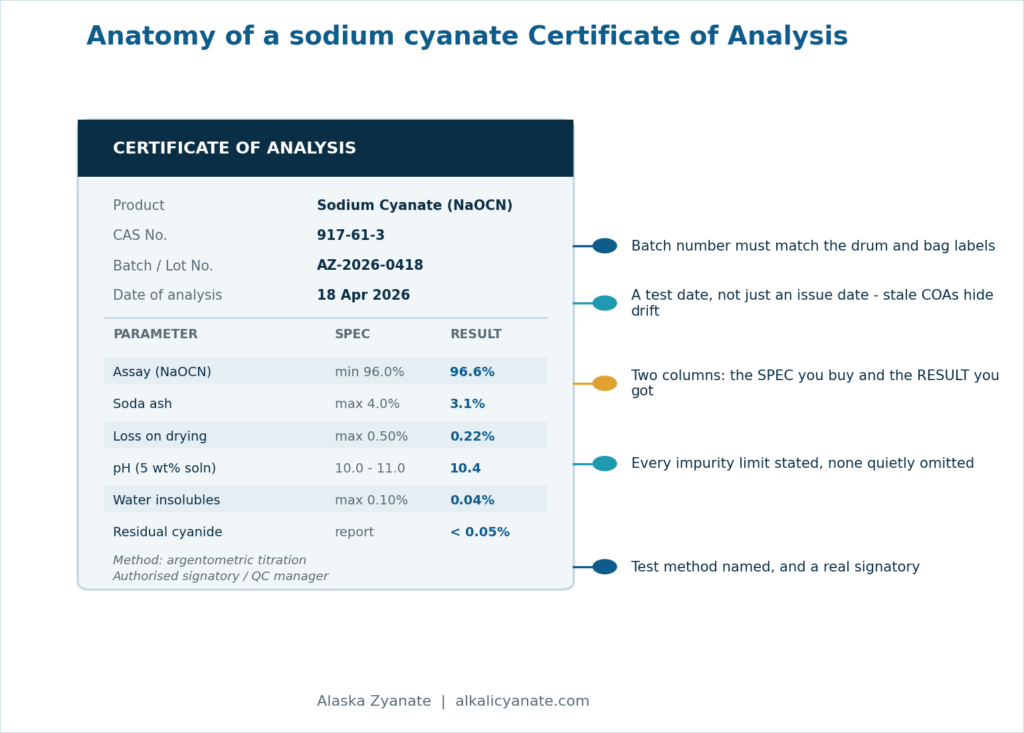
Before you buy sodium cyanate, six numbers on the Certificate of Analysis decide whether the batch is fit for your process: NaOCN assay (minimum 90% for technical grade, minimum 96% for high purity), soda ash content, loss on drying, pH of a 5 wt% solution, water-insoluble matter and residual cyanide. Confirm the CAS number reads 917-61-3, that the certificate carries a batch number and a test date, and that the assay method is named. Then verify the supplier: ISO 9001 certification, a current SDS, REACH status and a real export record. Purity is a claim until a batch-specific COA proves it.
What purity actually means for sodium cyanate
Purity, in this context, is the assay: the percentage of the bag that is genuinely sodium cyanate. The rest is not filler added to cut costs. It is mostly soda ash (sodium carbonate) that forms as a by-product during manufacture, alongside a little moisture and trace insolubles. So a 90% grade is not adulterated. It is a product whose production route left 10% carbonate behind.
This is where most first-time buyers go wrong. They compare a 90% figure from an industrial manufacturer against a 99% figure from a laboratory reagent house and conclude that one supplier is cutting corners. Those are two different markets. Reagent suppliers such as American Elements list sodium cyanate from 99% up to 99.999% in gram and kilogram quantities for analytical work. Nobody case-hardens steel with 99.999% material, and nobody would want to pay for it.
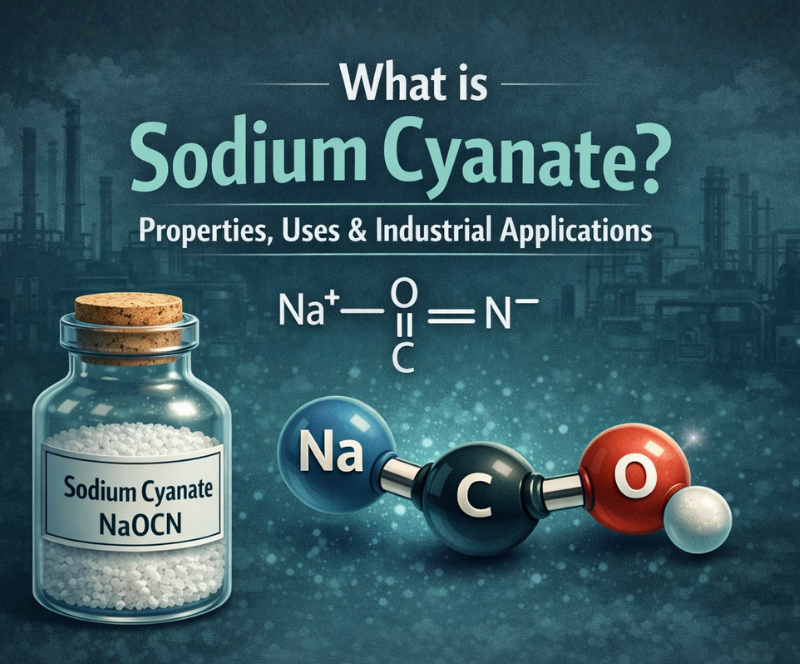
If you want the underlying chemistry rather than the commercial framing, our explainer on what sodium cyanate is covers the compound itself, and our comparison of technical grade against high-purity 96% walks through which one suits which process.
| Tier | Typical assay | Balance | Who buys it |
| Technical / industrial | min 90.0% NaOCN | up to 10% soda ash | Steel heat treatment, herbicide and pesticide synthesis, bulk intermediates |
| High purity | min 96.0% NaOCN | up to 4% soda ash | Pharmaceutical intermediates, dye intermediates, specialty chemicals |
| Reagent / analytical | 99% and above | under 1% | Research laboratories, method validation, reference work |
The six specifications that decide whether a batch is usable
A serious sodium cyanate specification runs to six lines. Anything shorter is a marketing sheet, not a technical one. Here is what each line is doing and how the number gets produced.
| Parameter | Typical limit | Why it matters | How it is tested |
| Assay (NaOCN) | min 90.0% or min 96.0% | Sets your stoichiometry. Under-assay means under-dosing and quiet yield loss. | Argentometric titration against silver nitrate, potassium chromate indicator |
| Soda ash (Na2CO3) | max 10.0% (90%) / max 4.0% (96%) | Alkaline carbonate load. Can shift pH and generate CO2 in acidic reaction media. | Acid-base titration |
| Loss on drying, 110 C | max 0.50% | Moisture. The single biggest driver of hydrolysis in storage. | Gravimetric, oven-dried to constant weight |
| pH, 5 wt% solution | 10.0 – 11.0 | A drop below 10 suggests hydrolysis has already started. | Calibrated pH meter, fresh solution |
| Water insolubles | max 0.10% (typical) | Grit and filter-blinding solids. Critical for salt baths and continuous dosing. | Filtration and gravimetric residue |
| Residual cyanide (CN-) | Report; typically well under 0.1% | Safety and regulatory exposure. Cyanate is not cyanide, but trace carry-over must be declared. | Titrimetric or spectrophotometric cyanide assay |
The assay method is worth pausing on. Sodium cyanate assay has been determined by silver nitrate titration with a potassium chromate indicator for decades, and the same approach also quantifies any sodium cyanide carried over. If a supplier will not name the method behind the number, treat the number as decorative.
Residual cyanide is the line buyers most often skip, usually because they assume the two compounds are interchangeable. They are not. We have written a full breakdown of sodium cyanate versus sodium cyanide, but the short version is that sodium cyanate carries the GHS warnings H302 and H412 and sits in a completely different hazard class. Ask for the figure anyway. A supplier who reports it is a supplier who measures it.
How to read a Certificate of Analysis without getting fooled
A Technical Data Sheet tells you what the product is meant to be. A Certificate of Analysis tells you what one specific batch actually was on one specific day. Buyers confuse the two constantly, and suppliers who are less than scrupulous are happy to let them.
Seven things that should stop you signing off
- No batch or lot number, or a batch number that does not match the drums and bags when they arrive.
- An issue date but no date of analysis. A certificate re-issued from a two-year-old test tells you nothing about this shipment.
- One column instead of two. You want the specification you are buying and the result that was measured, side by side.
- The phrase ‘typical value’ doing all the work. Typical values are not commitments and cannot be enforced in a claim.
- Selectively missing parameters. If moisture and insolubles are absent from an otherwise full certificate, ask why.
- No test method named against the assay.
- No named QC signatory. An unsigned PDF is a document, not a certificate.
The other habit worth building: ask for the COA before you place the order, not with the shipment. A supplier who can produce a real, batch-specific certificate on request is running a live QC lab. A supplier who takes four days to send one is very likely writing it. Our step-by-step procurement guide for international buyers sets out where this fits in the wider sequence.
Purity is not permanent: moisture, hydrolysis and storage
Here is the part almost nobody covers, and it is the part that causes the most disputes. The assay on the certificate describes the material as it left the plant. It does not describe the material sitting in your warehouse eight weeks later.
Cyanate salts hydrolyse. In aqueous conditions they break down to ammonia and bicarbonate, and the rate depends heavily on pH. ECHA’s registration data records that cyanate hydrolysis reached roughly 47% at pH 9 after five days at 50 C, and approached completion at pH 4 and pH 7 under the same conditions. The strong alkalinity of a sound batch, that 10.0 to 11.0 pH window, is precisely what holds the reaction back.
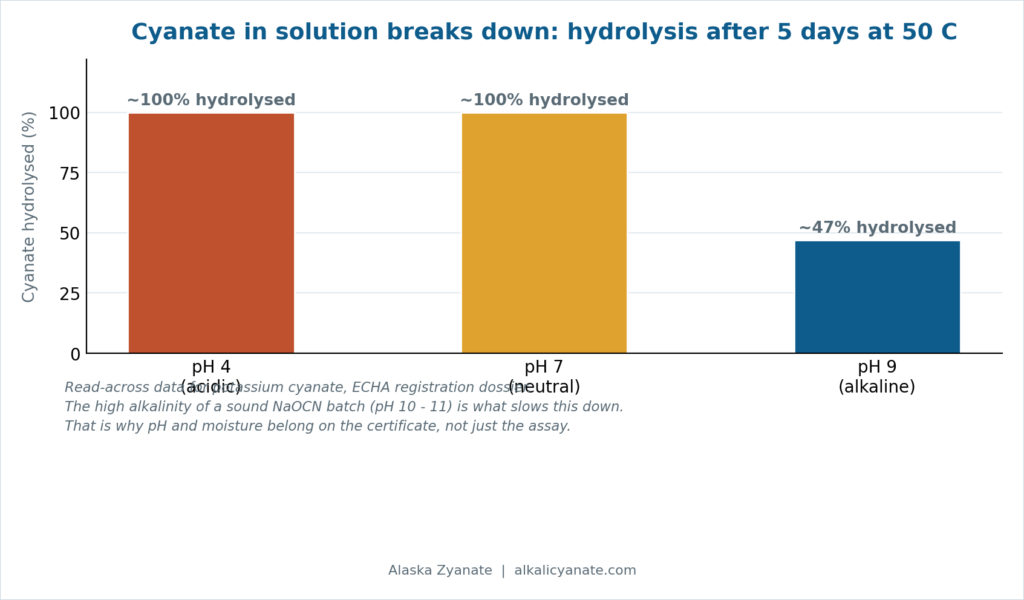
The practical consequence is that packaging and storage are purity controls, not logistics details. Sodium cyanate should arrive in HDPE or paper bags with an intact inner liner, or in lined jumbo bags for bulk volumes, and it should be stored dry, sealed and well away from acids. A split liner in a humid port warehouse will do more damage to your assay than the difference between a 90% and a 96% grade ever would.
What this means for your goods-inwards procedure
- Inspect liners and seals on arrival. Photograph any damage before the pallet moves.
- Re-test loss on drying and pH if the material has been in transit or storage for an extended period. These two are cheap, fast and catch most degradation.
- Keep a retained sample from each lot, sealed, so you can test back against the original COA if a batch later underperforms.
- Do not decant into open containers. Resealing matters more than it sounds like it should.
Matching the grade to the application
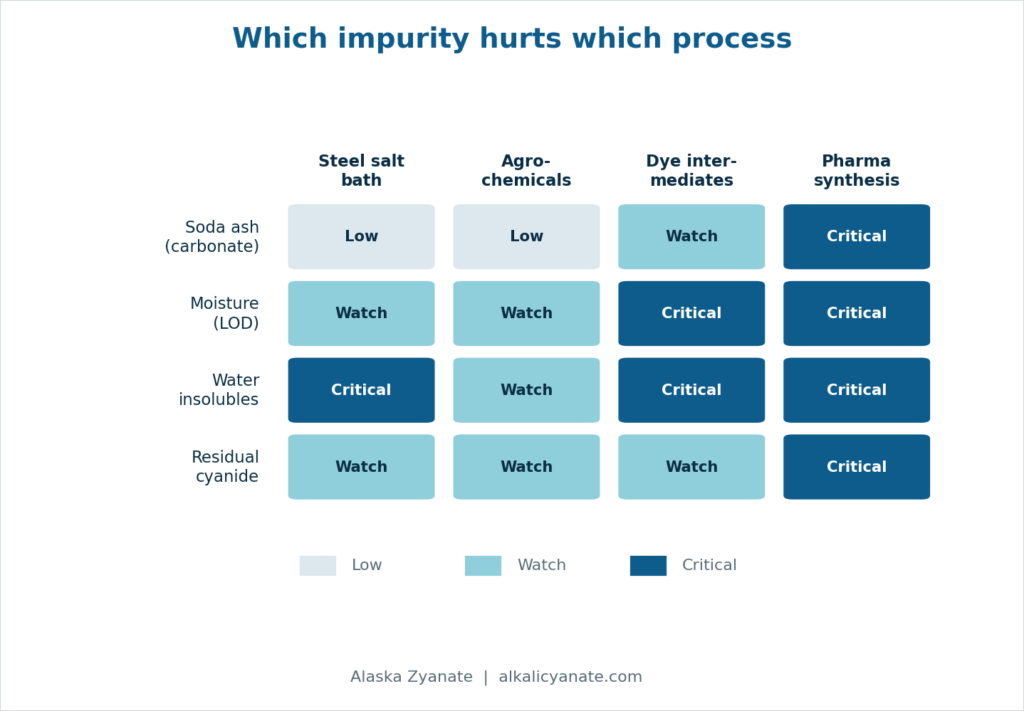
Over-specifying is a quieter waste than under-specifying, but it is still waste. The question is never ‘what is the purest grade available’, it is ‘which impurity would actually hurt this process’.
| Application | Grade that fits | The reason |
| Steel case hardening and salt baths | 90% technical | The bath runs above 500 C. Carbonate is inert at that temperature; insolubles are the real enemy. |
| Herbicide and pesticide synthesis | 90% technical | High volume, downstream purification handles the balance. Paying for 96% buys nothing. |
| Dye intermediates | 96% high purity | Colour consistency is the product. Batch-to-batch variation shows up in the final shade. |
| Pharmaceutical intermediates, urea derivatives, carbamates | 96% high purity | Impurity control is a regulatory obligation, not a preference. Carbonate can shift yields and create unwanted by-products. |
| Analytical and method validation work | 99%+ reagent | You are eliminating variables. Reagent houses serve this in small quantities. |
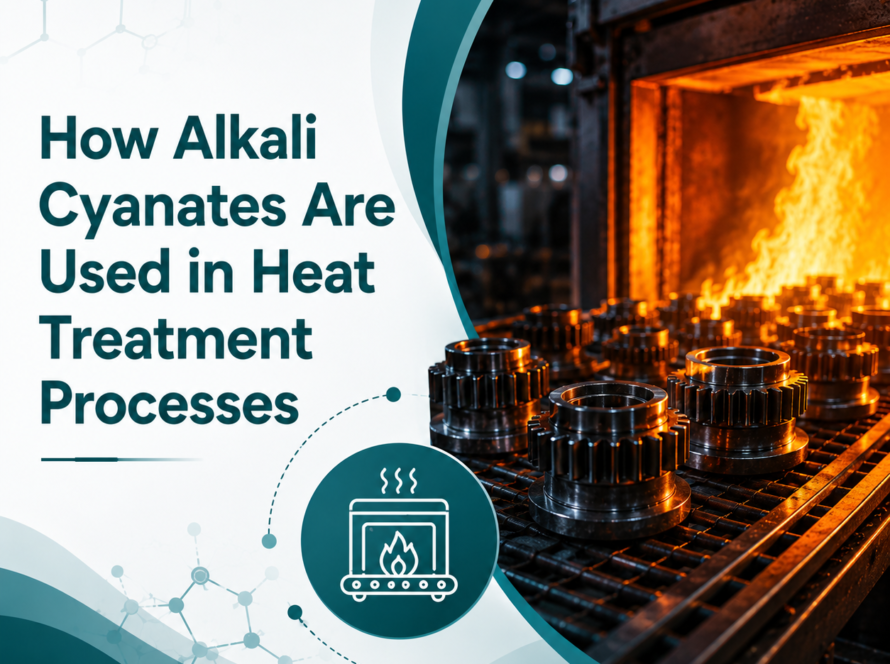
Sodium cyanate is registered with ECHA as a raw material for urea derivatives, semicarbazides, carbamates and isocyanates, and as a steel hardening agent. If your process sits in the first group, purity is a yield question. If it sits in the second, our piece on how alkali cyanates work in heat treatment explains why the technical grade holds up.
Verify the supplier, not just the sample
Any manufacturer can send a good sample. Consistency across twenty tonnes over eighteen months is a different capability, and it is the one you are really buying. Run this sequence before the first purchase order, not after the first failed batch.
The documentation pack you should receive without asking
- Technical Data Sheet (TDS) with full impurity limits, not a single assay figure. Alaska Zyanate publishes its NaOCN specification sheet openly.
- Batch-specific Certificate of Analysis (COA) against the lot you are buying.
- Safety Data Sheet (SDS) in GHS format, current revision, carrying the correct classification. Sodium cyanate is CAS 917-61-3, EC 213-030-6, PubChem CID 517096.
- Certificate of origin, commercial invoice and packing list for the import file. Cyanates classify under HS heading 2842.
- ISO 9001 certificate, current and verifiable, plus REACH registration status if you are importing into the EU.
The questions that separate manufacturers from traders
- Do you manufacture, or do you source? Ask for the plant address.
- What is your batch size, and can you trace a bag back to a production run?
- What is the assay method, and is your QC lab in-house?
- Will you accept a third-party ISO/IEC 17025 lab result as the arbiter if we disagree?
- What are your rejection terms if the delivered assay falls below spec?
That fourth question is the one that changes the temperature of a conversation. A manufacturer with a real QC function says yes without hesitating. Put the answer in the contract, along with the specification itself and a retained-sample clause. A specification that only lives in an email thread is not a specification.
Sourcing high-purity sodium cyanate from India
India has become a default sourcing point for alkali cyanates for the ordinary reasons: capacity, cost and export fluency. The variable is not the country. It is whether the specific supplier is set up for the technical and documentary demands of an international buyer.
Alaska Zyanate manufactures sodium cyanate in 90% and 96% grades from Ahmedabad, with sales offices in Germany and North America. Both grades ship against a published specification and a batch-specific COA, in 25 to 50 kg HDPE or paper bags with an inner liner, or 400 to 1,000 kg jumbo bags for bulk runs. We also supply potassium cyanate across the same quality framework.
What that structure buys you in practice is a shorter loop. Technical questions reach a person who can answer them, documentation arrives before the shipment rather than chasing it, and buyers in North America can work through our regional supply route rather than a distributor chain that adds a markup and removes the manufacturer from the conversation. Browse the full product range or ask us for a spec-matched sample.
Frequently asked questions
What is the standard purity of industrial sodium cyanate?
Industrial or technical grade sodium cyanate is normally supplied at a minimum assay of 90.0% NaOCN, with up to 10% soda ash as the balance. High-purity grades are supplied at a minimum of 96.0%, with soda ash capped at 4%. Laboratory reagent grades sit at 99% and above, but they are sold in small quantities for analytical work rather than for production.
What impurities should I check for in sodium cyanate?
Six parameters: assay, soda ash (sodium carbonate) content, loss on drying, pH of a 5 wt% solution, water-insoluble matter and residual cyanide. Soda ash and moisture are the two that most often cause process problems. Residual cyanide should be reported even though it is normally present only in traces.
What is the difference between a TDS and a COA?
A Technical Data Sheet describes the product specification in general: the grade, the limits, the physical properties and the packaging. A Certificate of Analysis reports the measured results for one specific manufactured batch, with a lot number and a test date. Buy against the TDS, accept delivery against the COA.
Does sodium cyanate lose purity in storage?
It can. Cyanate salts hydrolyse in the presence of moisture, breaking down to ammonia and carbonate, and the reaction accelerates sharply as pH falls. Sodium cyanate kept dry, sealed and away from acids is stable. Sodium cyanate in a split bag in a humid warehouse is not. Loss on drying and pH are the two fastest tests for catching this.
Is sodium cyanate the same as sodium cyanide?
No. They are chemically distinct compounds with different formulae, different reactivity and very different hazard classifications. Sodium cyanate (NaOCN, CAS 917-61-3) carries the GHS statements H302 and H412 under a Warning signal word. The confusion is common enough that it is worth stating clearly in your own purchasing paperwork.
Which grade of sodium cyanate do I need for steel heat treatment?
The 90% technical grade is the standard choice. Salt bath and case-hardening processes run above 500 C, at which point the soda ash content in the balance is chemically irrelevant. What does matter for these applications is water-insoluble matter, since insolubles accumulate in the bath.
Should I get sodium cyanate tested by an independent laboratory?
For pharmaceutical intermediates, dye work or any process where an out-of-spec batch would be expensive to unwind, yes. Use an ISO/IEC 17025 accredited laboratory and agree in advance, in the contract, that its result will be the arbiter in a dispute. For bulk technical-grade material with an established supplier, spot-checking new lots is usually proportionate.
What documents should a sodium cyanate supplier provide for export?
A Technical Data Sheet, a batch-specific Certificate of Analysis, a current GHS-format Safety Data Sheet, a certificate of origin, a commercial invoice and a packing list. An ISO 9001 certificate and REACH registration status should also be available on request. Cyanates classify under HS heading 2842 for customs purposes.