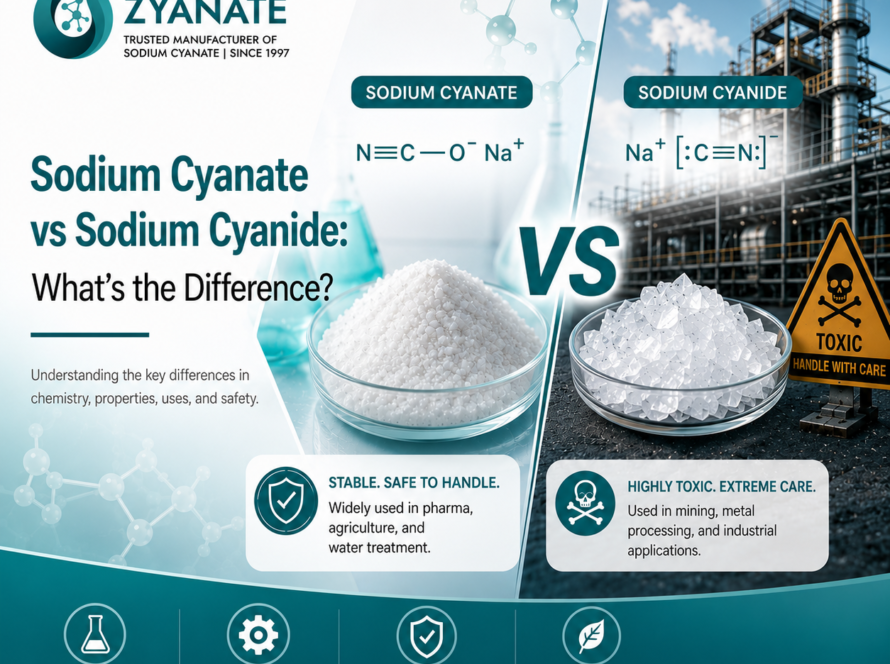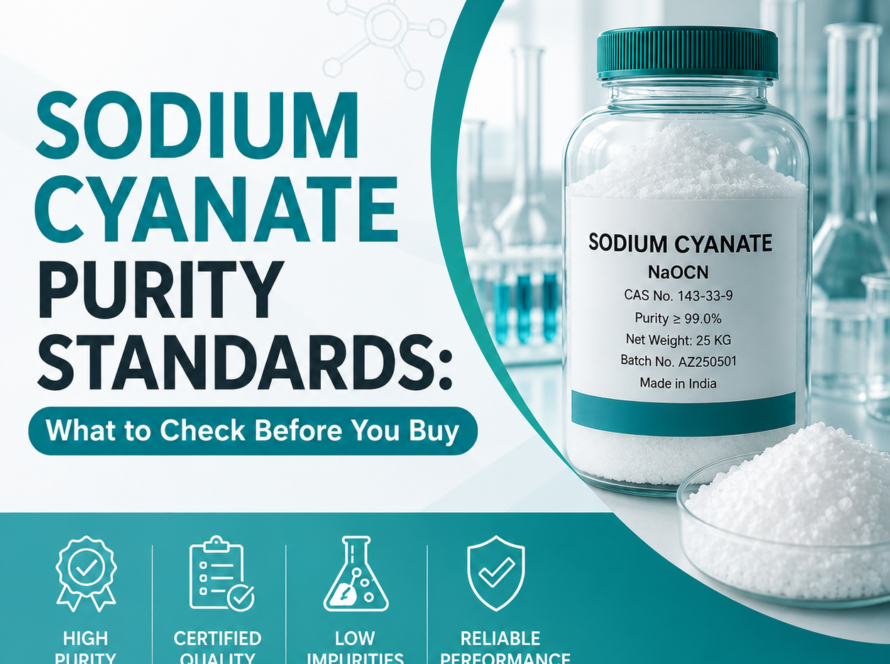


Walk into any procurement conversation around sodium cyanate and you’ll hear the same question come up sooner or later, 90% or 96%? It sounds like a minor detail. But for industries where chemical consistency directly ties to product quality, that number carries more weight than it looks.
Knowing the real difference between sodium cyanate grades isn’t just useful for lab managers or chemists. It matters to anyone sourcing this compound at scale, whether you’re in pharmaceuticals, metallurgy, agrochemicals, or research. The wrong grade won’t always cause an obvious failure. Sometimes it just quietly chips away at yields, reaction consistency, and batch quality until something flags in QC and nobody quite knows why.
This blog breaks down what separates technical-grade sodium cyanate from high-purity sodium cyanate 96%, why each exists, and how choosing correctly actually improves your operation, not just on paper, but in practice.
Understanding Sodium Cyanate Grades: What the Numbers Mean
Sodium cyanate (NaOCN) is a white, odourless crystalline powder with a molecular weight of 65.01 g/mol. It’s stable, reactive enough for a wide range of synthesis applications, and used globally across multiple industries. But the compound itself doesn’t tell the full story, the grade does.
When manufacturers talk about sodium cyanate grades, they’re referring to the minimum NaOCN assay, the actual percentage of sodium cyanate content in the product. The rest? Mostly soda ash, which forms naturally during production. A 90% grade carries up to 10% soda ash. A 96% grade limits that to just 4%.
Both grades share the same physical and chemical identity: white free-flowing powder, pH between 10.0 and 11.0 in a 5 wt% solution, loss on drying below 0.50%, and a density of 1.893 g/cm³. The molecule doesn’t change. What changes is how much of it is actually in the bag you’re buying, and that difference ripples outward into your process in ways that are worth understanding before you place an order.
Technical-Grade Sodium Cyanate: Built for Industrial Reality
There’s a misconception that technical-grade means inferior. It doesn’t. Technical-grade sodium cyanate is specifically suited for industrial processes that don’t require pharmaceutical-level purity, which, honestly, is the majority of sodium cyanate applications worldwide.
- Standard, Not “Sub-par”: There is a common myth that technical-grade is just a “lower” version of the good stuff. In reality, it is simply the right tool for the job for most global applications that don’t need pharma-level specs.
- Built for Extreme Heat: Take steel surface hardening or salt bath treatments. When you are operating at over 500°C, the chemistry of technical-grade sodium cyanate performs perfectly. At those temperatures, the soda ash content isn’t a dealbreaker, it’s a non-issue.
- The Go-To for Agrochemicals: In the world of herbicide and pesticide production, you are moving massive volumes. Using 96% purity here usually doesn’t make financial sense because the chemistry works just as well with the technical grade. It’s about being cost-effective without losing potency.
- Workhorse of Industrial Synthesis: For organic chemical intermediates, technical-grade isn’t some “budget workaround”, it is the industry standard. Since downstream processing usually cleans up any leftovers, it’s the most logical choice for bulk manufacturing.
- Practical Procurement: At the end of the day, sourcing this in bulk from a reliable sodium cyanate supplier is about matching the purity to the actual needs of the plant, rather than over-paying for purity you don’t actually use.
High-Purity Sodium Cyanate 96%: When Accuracy Isn’t Optional
Some processes leave no room for variability. In those cases, high-purity sodium cyanate 96% isn’t a premium option, it’s the only option that makes sense
- When Precision is the Priority: For some setups, high-purity sodium cyanate 96% isn’t just a “nice-to-have” upgrade, it’s the only way to ensure your process actually works the way it should.
- Cleaner Pharma Outcomes: In pharmaceutical intermediate synthesis, purity levels are everything. Even a tiny amount of soda ash can mess with your yield or create by-products you don’t want. Using the 96% grade keeps the reaction predictable, which is essential when you’re working in a highly regulated environment.
- Reliable Lab Results: If you’re running validation or analysis in a research laboratory, you need to eliminate variables. Starting with high-purity reagents means you aren’t stuck wondering if a weird result came from your experiment or an impurity in your chemicals.
- Consistency in Specialty Chemicals: For things like specialty chemical manufacturing, especially dye intermediates, color accuracy is the goal. That 6% difference in purity between 90% and 96% might seem small on paper, but in production, it’s the difference between a consistent product and one you have to constantly fix.
- Trusting the Math: Ultimately, higher purity means you spend less time second-guessing your batches and more time moving through production with confidence.
How the Right Sodium Cyanate Grade Improves Operations
Choosing the correct grade isn’t just about chemistry, it has real operational consequences.
- Smart Cost Management: Chemistry is great, but the budget matters. Using technical-grade where it makes sense keeps your costs down without hurting the final result.
- Avoiding the “Cheap” Trap: Precision work needs 96% high-purity sodium cyanate. Skimping here usually backfires when you have to toss out a failed batch or redo quality control, which ends up costing way more than the “expensive” grade ever would.
- Paperwork That Doesn’t Suck: Chasing a supplier for batch codes and certificates is a waste of your team’s time. Getting clear documentation the first time means one less administrative fire to put out.
- Sizing That Actually Fits: Whether you need 25kg bags for easy handling or 1,000kg jumbo bags for bulk runs, the packaging should match how your floor actually operates, not just what’s easiest for the warehouse to ship.
Choose a Sodium Cyanate Manufacturer Who Understands Your Application
The grade matters. But so does who you’re buying it from.
A sodium cyanate manufacturer who genuinely understands industrial applications can do more than ship products. They can tell you clearly which grade fits your process, provide accurate documentation, and maintain supply consistency even at scale. Alaska Zyanate is an ISO-certified sodium cyanate manufacturer headquartered in Ahmedabad, India, with sales offices operating in Germany and North America, a structure built to serve industrial buyers across regions without the sourcing friction that often comes with international chemical procurement.
Both the 90% technical-grade and high-purity sodium cyanate 96% are produced under strict quality protocols, with full specification transparency. Whether you’re a procurement manager handling bulk orders or a technical buyer who needs grade-specific data before signing off, working with the right sodium cyanate supplier from the start makes every part of the process smoother.
Conclusion
Technical-grade and high-purity sodium cyanate 96% are both legitimate, well-suited products, just for different jobs. Technical-grade covers the broad industrial territory where purity requirements are moderate and volume is high. The 96% grade exists for applications where impurity control is non-negotiable and results need to be consistent every single time.
Understanding the difference isn’t complicated. Applying that understanding to your sourcing decisions is what separates operations that run efficiently from ones that spend too much time chasing problems they didn’t need to have.
Contact Alaska Zyanate today to find the right sodium cyanate grade for your industrial applications. Reach out through alkalicyanate.com and get the grade, documentation, and supply reliability your process actually needs.