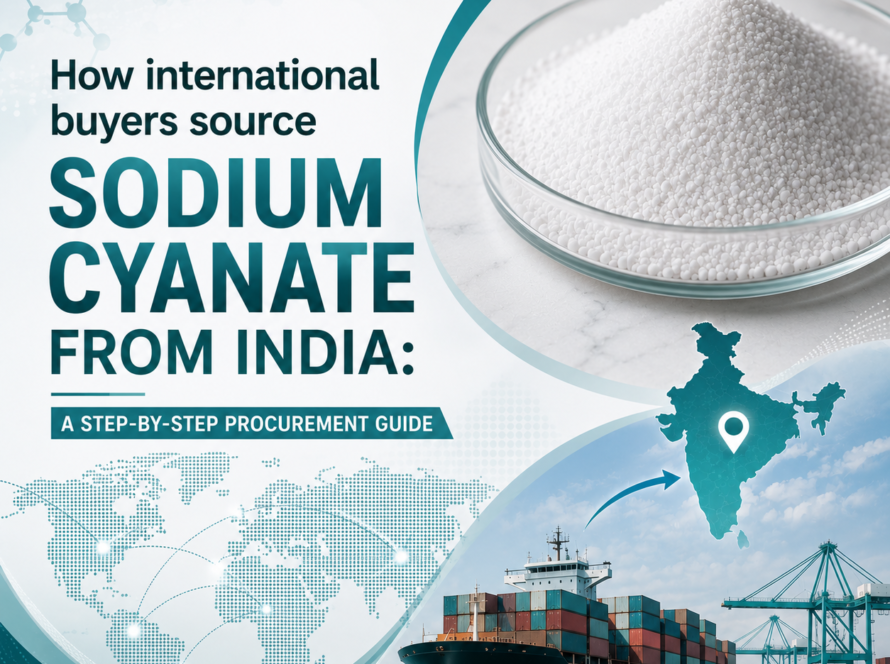


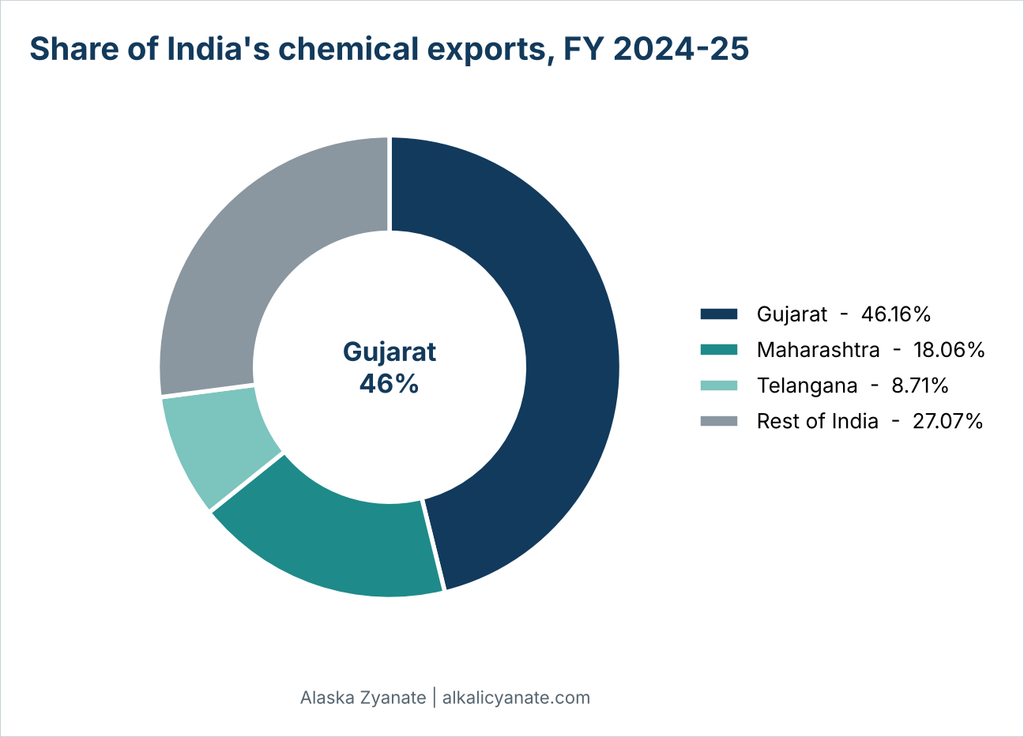
The safest way to buy from a sodium cyanate manufacturer in India is to deal directly with a Gujarat plant that makes NaOCN (CAS 917-61-3) itself, publishes a grade specification, and sends a batch-specific COA and SDS with every consignment. India is a sensible place to source it. Gujarat alone shipped 46% of India’s chemical exports in FY 2024-25, and its producers sit close to their raw materials and to the container ports at Mundra and Nhava Sheva.
This guide is for procurement teams outside India. It covers what sodium cyanate is, the grades on offer, how to tell a manufacturer from a trader, which documents to insist on, and what to agree on MOQ, packaging, Incoterms and lead times before you pay a deposit. We have made sodium cyanate in Ahmedabad since 1997, so most of what follows comes from questions buyers actually ask us.
What is sodium cyanate (NaOCN)?
Sodium cyanate is the sodium salt of cyanic acid: a white, odourless, free-flowing crystalline powder with the formula NaOCN and CAS number 917-61-3. Industrially it is made by heating urea with sodium carbonate, which forms a sodium allophanate intermediate that then breaks down to sodium cyanate.
That production route explains the most important line on any specification sheet. Unreacted soda ash is the main impurity, so the soda ash limit tells you as much about a grade as the assay does. Our introduction to sodium cyanate covers the chemistry in more depth.
| Property | Value |
| Chemical name | Sodium cyanate (cyanic acid, sodium salt) |
| Formula | NaOCN |
| CAS number | 917-61-3 |
| EC number | 213-030-6 |
| Molar mass | 65.01 g/mol |
| Appearance | White, odourless, free-flowing crystalline powder |
| Melting point | About 550 °C |
| Density | 1.893 g/cm3 |
| GHS signal word | Warning (H302, H412) |
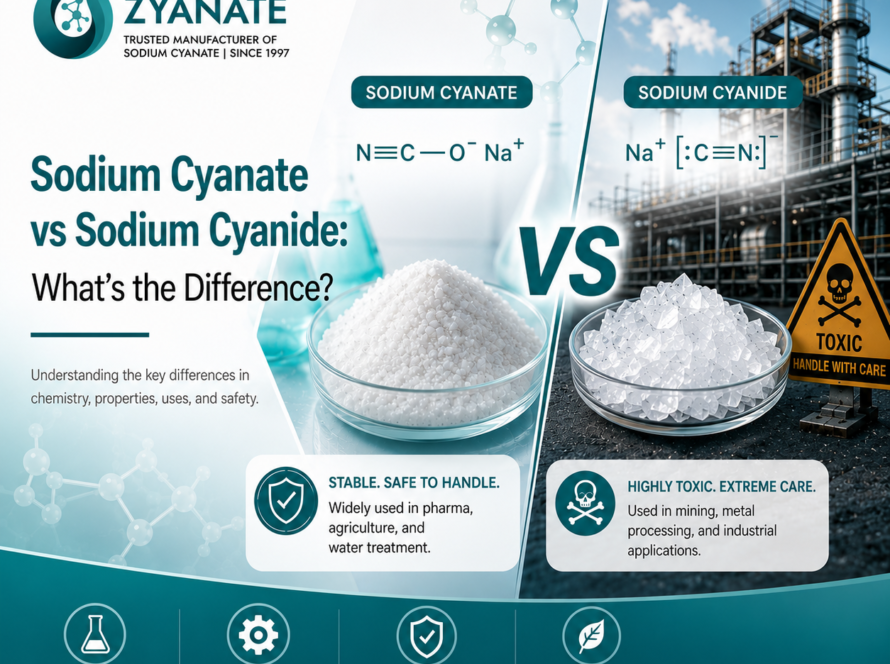
One point we repeat to every new buyer: sodium cyanate is not sodium cyanide. The two have different hazard profiles, different customs headings and different transport rules, and mixing them up on a purchase order or shipping document causes delays at the port. Our comparison of sodium cyanate vs sodium cyanide sets out the differences.
What is sodium cyanate used for?
Steel hardening is its largest single use. Most of the remaining demand comes from chemical synthesis, where sodium cyanate supplies the cyanate group for ureas and related intermediates.
Metal heat treatment and case hardening
In salt-bath processes such as liquid nitrocarburising, cyanate in the molten bath gives up carbon and nitrogen to the steel surface. The result is a hard, wear-resistant case over a tougher core. Bath-salt makers and heat treaters use sodium cyanate in these formulations, and because the bath already contains carbonate, the 90% grade is normally the right choice. Our article on alkali cyanates in heat treatment processes explains the bath chemistry.
Agrochemicals
Sodium cyanate is an intermediate in herbicide and pesticide synthesis, and in some markets it has been used directly for weed control. If you plan direct agricultural use, check the product registration rules in your country first, because they vary a lot from one market to the next. Agrochemical intermediates are usually made with the 90% grade.
Pharmaceuticals and organic synthesis
Chemists use sodium cyanate to generate cyanic acid in situ, which reacts with amines to give unsymmetrical ureas. Many drug intermediates, fine chemicals and dye intermediates are built this way. These buyers normally specify the 96% grade, where the lower soda ash content gives a more predictable reaction.
| Application | Grade most buyers specify | Why |
| Steel case hardening, salt baths | 90% | Carbonate in the bath tolerates higher soda ash |
| Agrochemical synthesis | 90% | Cost-sensitive intermediate chemistry |
| Pharmaceutical intermediates | 96% | Lower impurity load, tighter process control |
| Fine chemicals, research, labs | 96% | Predictable assay for synthesis work |
Why source sodium cyanate from India?
India’s case rests on two things: a dense chemical manufacturing base in Gujarat, and decades of export practice that most established producers now take for granted.
A manufacturing base in Gujarat
Gujarat is India’s chemical heartland. CHEMEXCIL figures show the state exported US$12.9 billion of chemicals in FY 2024-25, 46.16% of the national total and well ahead of Maharashtra at 18%. Ahmedabad, Vadodara, Bharuch and Vapi host clusters of chemical plants, packaging suppliers and freight forwarders that have worked together for years.
For sodium cyanate in particular, raw material supply matters. Most of India’s soda ash is made on Gujarat’s Saurashtra coast, and urea is produced at scale across the country, including in Gujarat. A plant in Ahmedabad can buy both without long inland hauls.
Cost competitiveness
Indian manufacturers generally run with lower conversion costs than plants in Europe or North America, and that usually survives into the landed price even after sea freight. Lower cost is not a reason to accept the cheapest quote you receive, though. We come back to that in the section on risks.
Export experience
Established Indian exporters ship to Europe, North America, the Middle East and Southeast Asia every month, and they know the paperwork each market expects. Alaska Zyanate supports buyers through sales offices in Germany and North America and exports to sodium cyanate buyers in the USA and buyers in Canada.
If you are new to importing chemicals from India, our step-by-step procurement guide walks through the process from first enquiry to delivery.
What international buyers should check before ordering
When buyers come to us after a bad experience elsewhere, the cause is nearly always something that was never checked before the deposit went out. Work through these six checks in order.
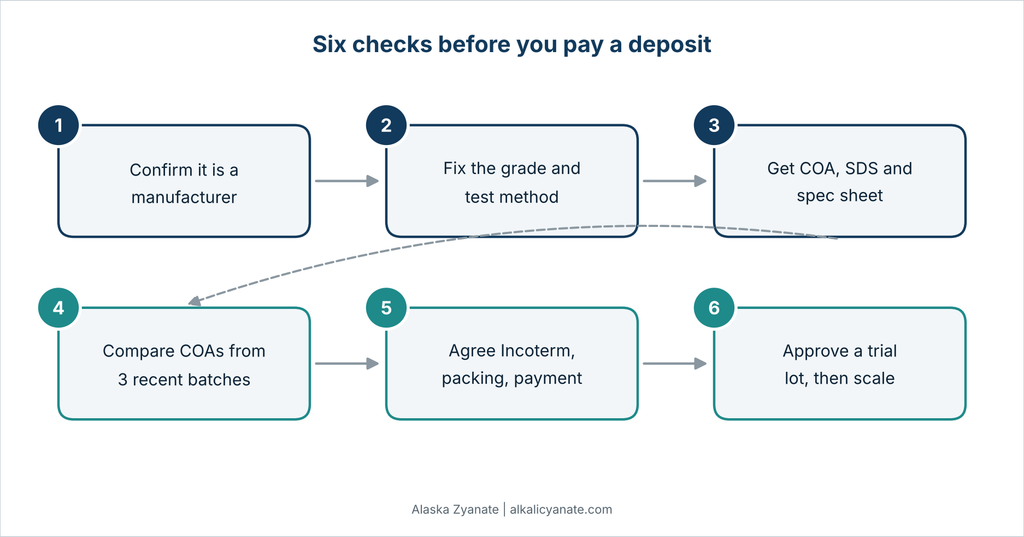
Manufacturer or trader?
Traders are not automatically a bad choice. Some add value through consolidation or local stock. But a trader adds margin, and it usually cannot tell you which plant made your batch or change anything when a batch fails. A genuine manufacturer can answer all of these questions without hesitation:
• What is the plant address, and can we see it on a video call or a visit?
• What is your annual capacity for sodium cyanate?
• Who signs the COA, and is the laboratory on the same site?
• Can you show batch numbers that match across the bags, the COA and the invoice?
• Do you make any other products on the same line?
The last question matters more than it looks. A plant that runs other chemicals on shared equipment carries a cross-contamination risk. Our Ahmedabad facility makes only sodium and potassium cyanate, on a 1.5-acre site with 3,600 tonnes a year of sodium cyanate capacity. You can read more about our plant and team.
Purity and grade specifications: 90%, 96% and the 98% question
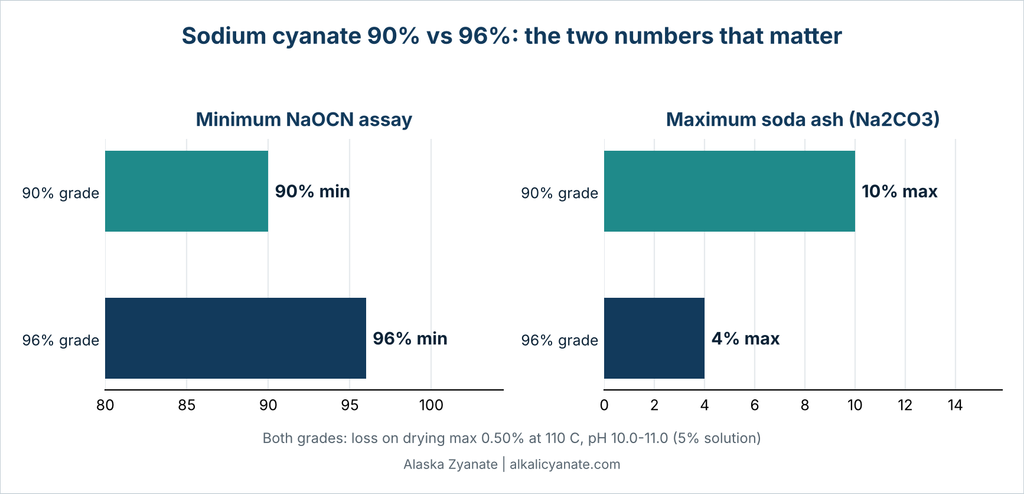
Sodium cyanate is sold on a minimum assay. Our two standard grades are below, taken from the sodium cyanate product specification.
| Parameter | 90% grade | 96% grade |
| Sodium cyanate (NaOCN), min | 90.00% | 96.00% |
| Soda ash (Na2CO3), max | 10.00% | 4.00% |
| Loss on drying at 110 °C, max | 0.50% | 0.50% |
| pH (5% solution) | 10.0 to 11.0 | 10.0 to 11.0 |
| Appearance | White free-flowing powder | White free-flowing powder |
You will see some suppliers advertise 98% or 99% sodium cyanate. Treat any figure above 96% as a question rather than an answer: ask for the COA, the test method and the date of analysis, then test a retained sample yourself. If your process genuinely needs material above 96%, raise it at enquiry stage and we will tell you plainly what we can supply.
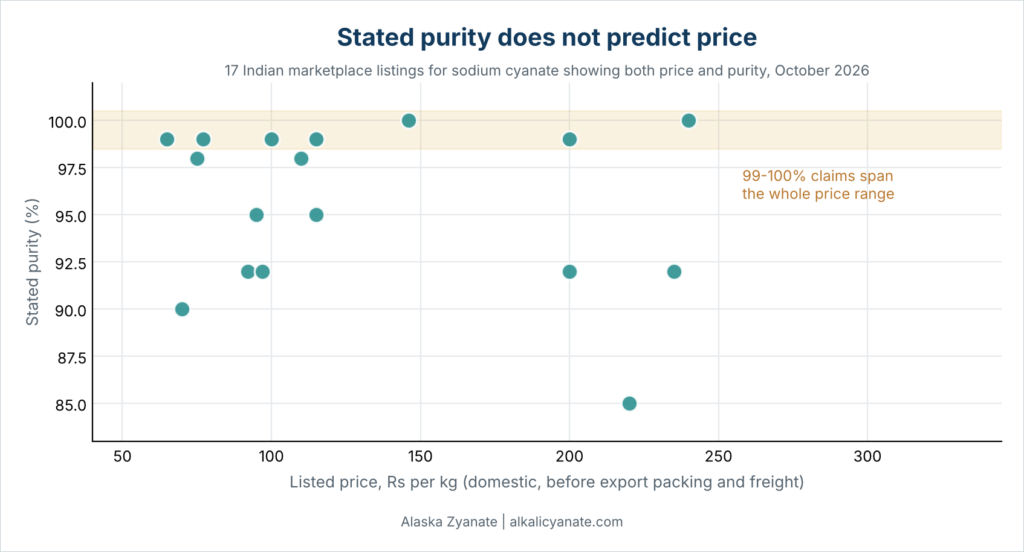
This is not just caution for its own sake. When we looked at 17 Indian marketplace listings that show both a price and a purity, the stated purity told us almost nothing about the price. Listings claiming 99% or 100% sat at both the bottom and the top of the range. A number on a listing is a claim. A batch COA backed by your own test is evidence.
COA, SDS (MSDS) and compliance documents
Ask for these before you confirm the order, not after the goods have sailed:
• A Certificate of Analysis (COA) for the specific batch, showing assay, soda ash, loss on drying, pH, batch number and date of analysis.
• A Safety Data Sheet (SDS, still often called MSDS) in the 16-section GHS format. EU and UK buyers need it in their own language.
• The product specification sheet, signed by the manufacturer.
• The commercial invoice, packing list, certificate of origin and bill of lading.
• Confirmation of how the substance is covered under your local chemicals law, such as EU REACH, UK REACH or TSCA in the United States.
Read the hazard section as well. Sodium cyanate is classified as harmful if swallowed (H302) and harmful to aquatic life with long-lasting effects (H412). Several published SDSs show no UN number for it, but section 14 of your supplier’s own SDS is the one to rely on for transport classification.
One more paperwork point. Cyanates are normally declared under HS subheading 2842.90, not under heading 2837, which covers cyanides. Confirm the code with your customs broker before the first shipment, because a cyanide heading on a cyanate invoice is a reliable way to get a container held for inspection.
Batch consistency and quality control
A single good COA proves very little. Ask for COAs from three recent production batches and compare them. On a well-run plant the assay sits in a tight band comfortably above the minimum, and soda ash and moisture barely move from batch to batch.
Then ask how the plant keeps it that way. At our facility, consistency comes from high-purity raw materials, mechanised operations with minimal manual handling, and strict in-process controls during every batch. Because the plant is dedicated to cyanates, there is no changeover from unrelated products to manage.
Packaging, MOQ, shipping and payment terms
Settle these points on the proforma invoice. Verbal agreements on packing or delivery terms are where most avoidable disputes start.
| Term | What to agree | Alaska Zyanate standard |
| Packaging | Bag size, liner, palletising, labelling | 25 kg or 50 kg HDPE or paper bags with inner liner; 400 kg to 1,000 kg jumbo bags |
| Samples | Quantity and cost | 25 kg to 100 kg trial lots, priced as samples |
| MOQ | Pilot and commercial quantities | Pilot orders from about 500 kg; per-tonne pricing from about 5 tonnes |
| Container load | Tonnes per container | About 18 tonnes in 25 kg bags in a 20 ft container |
| Incoterms | Term plus a named port | EXW, FOB and CIF to most destinations |
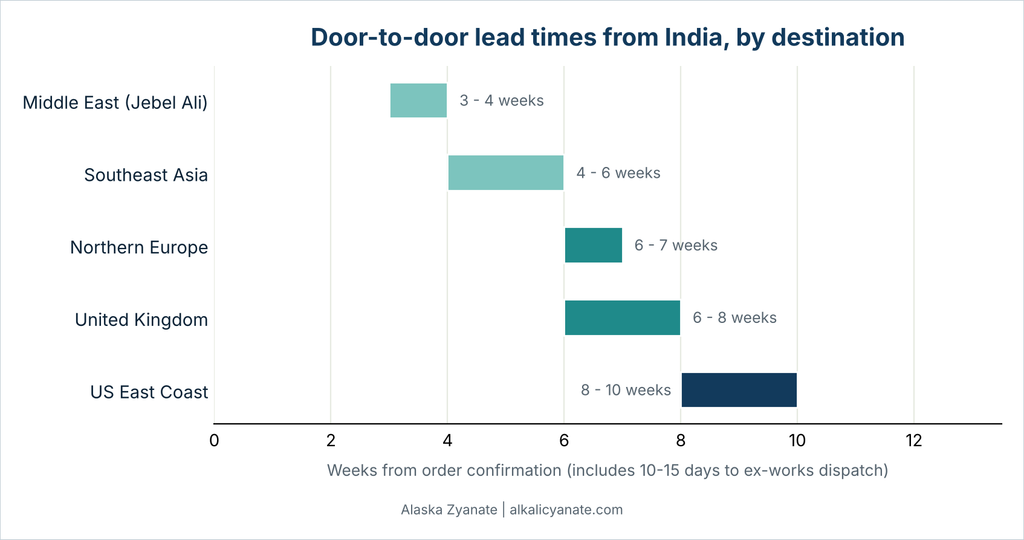
| Lead time | Ex-works and door to door | 10 to 15 days ex-works; about 3 to 10 weeks door to door |
| Payment | Method, currency, timing | Agreed per order; production starts once the advance or LC is received |
Sodium cyanate packaging and MOQ
25 kg bags suit buyers who dose by hand or have smaller warehouses, while jumbo bags cut handling and packaging cost on larger orders. Whichever you choose, the inner liner matters more than the outer bag: a sealed liner keeps moisture out and stops the powder caking in transit. Our sodium cyanate bulk order guide covers container loading, palletising and MOQ bands in detail.
FOB, CIF and lead times
Under FOB, the manufacturer clears the goods for export and loads them at an Indian port, and you arrange the sea freight. Under CIF, the manufacturer also pays freight and minimum insurance to your destination port, but risk passes to you once the goods are on board in India. Always name the place and the rules version, for example “FOB Mundra, Incoterms 2020”.
Expect 10 to 15 days from order confirmation to ex-works dispatch. Sea transit then depends on where you are.
Sodium cyanate price per kg and per tonne
We do not publish an export price list, and we would be wary of any supplier who quotes a firm figure without knowing your grade, volume, packaging and destination. Those four factors, plus the Incoterm, freight rates and the rupee exchange rate, set your landed cost.
As a rough reference point, Indian domestic marketplace listings for industrial sodium cyanate mostly sat between about ₹65 and ₹240 per kg in October 2026, or roughly ₹65,000 to ₹240,000 per tonne. Those are domestic prices before export packing, freight and documentation, so use them as context rather than a benchmark. A written quotation on your exact terms is the only number worth planning around.
Payment terms
Most Indian exporters work on an advance payment, a letter of credit at sight, or a mix of the two for repeat buyers. Production usually starts once the advance or LC arrives, so a slow LC opening pushes the whole timeline back. Agree the payment structure, currency and bank details in writing, and confirm any change of bank details by phone with a contact you already know before you pay.
Common sourcing risks and how to avoid them
The most common mistake we see is a buyer choosing on price alone, then discovering the real cost later in a failed batch or a held container. These are the problems that come up most often.
| Risk | Warning sign | How to avoid it |
| Inconsistent purity | Assay close to the minimum, or COAs that never vary at all | Write grade, test method and tolerance into the contract; test a pre-shipment sample |
| Missing or wrong paperwork | SDS not in GHS format; COA without a batch number | Agree the full document list before freight is booked |
| Unclear Incoterms | “CIF” with no named port or rules version | State the term, the named place and Incoterms 2020 |
| Cyanate and cyanide confusion | Wrong product name or HS code on documents | Check invoice, packing list and SDS before dispatch |
| Caking and moisture damage | Bags without an inner liner; open storage | Specify lined, palletised, shrink-wrapped bags; store sealed and dry |
| Trader presenting as a manufacturer | No plant address; vague answers on capacity | Ask for a video tour and written capacity figures |
| Payment fraud | A last-minute change of bank details | Confirm by phone with a known contact before paying |
None of these problems is unusual. Every one is cheap to prevent before an order and expensive to fix after one.
Why buyers choose Alaska Zyanate as their sodium cyanate manufacturer in India
We started as Erric Industries in 1997 and have traded as Alaska Zyanate since 2009. Everything we sell is made at one dedicated plant in Ahmedabad, Gujarat, built for alkali cyanates and nothing else.
• Annual capacity of 3,600 tonnes of sodium cyanate and 700 tonnes of potassium cyanate
• Two sodium cyanate grades, 90% and 96% minimum assay, each shipped with a batch COA and SDS
• A 1.5-acre facility used only for sodium and potassium cyanate, which removes cross-contamination from other product lines
• Sales offices in Schwäbisch Hall, Germany, and in North America, so buyers there can deal with us in their own time zone
• Packing from 25 kg bags to 1,000 kg jumbo bags, shipped EXW, FOB or CIF
If you are comparing suppliers, start with the full sodium cyanate specification or see all our cyanate products. Buyers deciding between the two salts may find our sodium cyanate vs potassium cyanate comparison useful.
Frequently asked questions
Where are sodium cyanate manufacturers in India located?
Most are in Gujarat, around Ahmedabad, Vadodara and Vapi, close to soda ash and urea supply and to the container ports at Mundra and Nhava Sheva. Alaska Zyanate’s sodium cyanate plant is in Ahmedabad.
What purity of sodium cyanate can I buy from India?
Industrial sodium cyanate is usually sold as a 90% or 96% minimum assay grade. The 96% grade has a lower soda ash limit (4% maximum against 10%) and suits pharmaceutical and fine chemical work. Ask for a batch Certificate of Analysis to back up any purity claim, including 98%.
What is the minimum order quantity for sodium cyanate?
Trial lots of 25 kg to 100 kg are available for qualification. Pilot orders start at around 500 kg, and commercial per-tonne pricing usually applies from about 5 tonnes. A 20 ft container holds about 18 tonnes in 25 kg bags.
How is sodium cyanate packed and shipped for export?
It is packed in 25 kg or 50 kg HDPE or paper bags with an inner liner, or in 400 kg to 1,000 kg jumbo bags, then palletised and shipped by sea on EXW, FOB or CIF terms. Dispatch takes 10 to 15 days, and door-to-door delivery takes about 3 to 10 weeks depending on the destination.
What documents come with a sodium cyanate export order?
A batch Certificate of Analysis (COA), a GHS-format Safety Data Sheet (SDS or MSDS), the product specification sheet, the commercial invoice, packing list, certificate of origin and bill of lading.
What is the price of sodium cyanate per kg?
Export prices depend on grade, volume, packaging, Incoterm and destination, so manufacturers quote per order. Indian domestic marketplace listings mostly fall between about ₹65 and ₹240 per kg, but a written export quotation on your exact terms is the figure to plan with.
Request a sodium cyanate quote or sample
For an accurate quotation, send us your grade (90% or 96%), first-order and annual quantity, packaging preference, destination port, preferred Incoterm, and any documents your customs or quality team needs.
Email sales@alkalicyanate.com, call our Ahmedabad export desk on +91-9825039131, or use our contact form. We reply with a written quotation and can send a trial sample so your laboratory can qualify the material before you commit to a full order.