

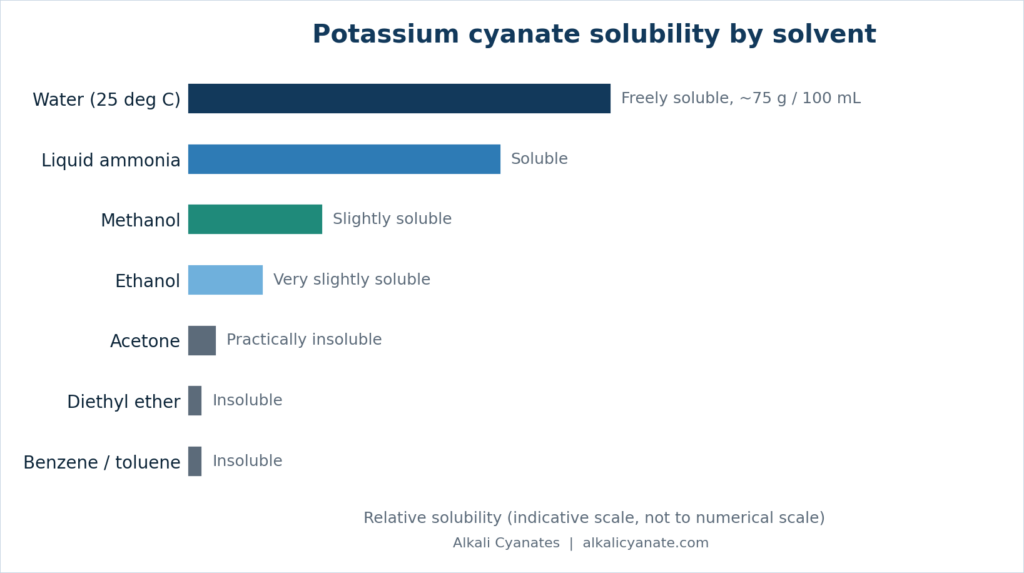
Potassium cyanate (KOCN, CAS 590-28-3) is a white crystalline salt with a molecular weight of 81.12 g/mol. It melts at 315 °C and has a density close to 2.05 g/cm3. It dissolves readily in water, around 75 g per 100 mL at 25 °C, but only slightly in alcohols and not at all in most organic solvents. The dry solid is stable for long periods when it is kept cool and sealed. Once dissolved, it hydrolyses steadily to ammonia and potassium bicarbonate, and both acid and heat make that happen a great deal faster.
Potassium cyanate identifiers and chemical properties
Before any technical discussion, it helps to pin down exactly which material is under review. Cyanate salts are routinely confused with cyanide salts in purchasing systems, and the two are not interchangeable in any sense.
| Identifier | Value |
| Chemical name | Potassium cyanate |
| Common synonyms | Potassium isocyanate, cyanic acid potassium salt, KOCN |
| Molecular formula | KOCN (also written KNCO) |
| CAS number | 590-28-3 |
| Molecular weight | 81.12 g/mol |
| Ionic composition | Potassium cation (K+) and cyanate anion (OCN-) |
| Appearance | White to off-white crystalline powder |
| Odour | Odourless when dry |
| Crystal system | Tetragonal at room temperature |
The cyanate anion carries a single negative charge and is built from one nitrogen, one carbon and one oxygen atom. That oxygen is the whole story. It is what separates cyanate chemistry from cyanide chemistry, and it is why the two salts behave so differently in a plant.
Physical properties of potassium cyanate
The figures below are the values you will see repeated across supplier literature and reference databases. Treat them as typical rather than absolute. Bulk density in particular shifts with particle size and how the material has been handled, so always work from the certificate of analysis that ships with your batch. Our potassium cyanate product page sets out the grades we hold.
| Physical property | Typical value |
| Physical state | Solid, crystalline powder or fine granules |
| Colour | White to off-white |
| Melting point | 315 °C |
| Boiling point | Not applicable, the salt decomposes before it boils |
| Density | 2.05 g/cm3 at 20 °C |
| Bulk density | Roughly 0.9 to 1.1 g/cm3, depending on particle size |
| Solubility in water | About 75 g per 100 mL at 25 °C |
| pH, 5% aqueous solution | 7 to 9, mildly alkaline |
| Hygroscopic | Mildly, enough to cause caking in humid stores |
| Thermal stability | Stable as a dry solid, breaks down on strong heating |
Potassium cyanate solubility: water and organic solvents
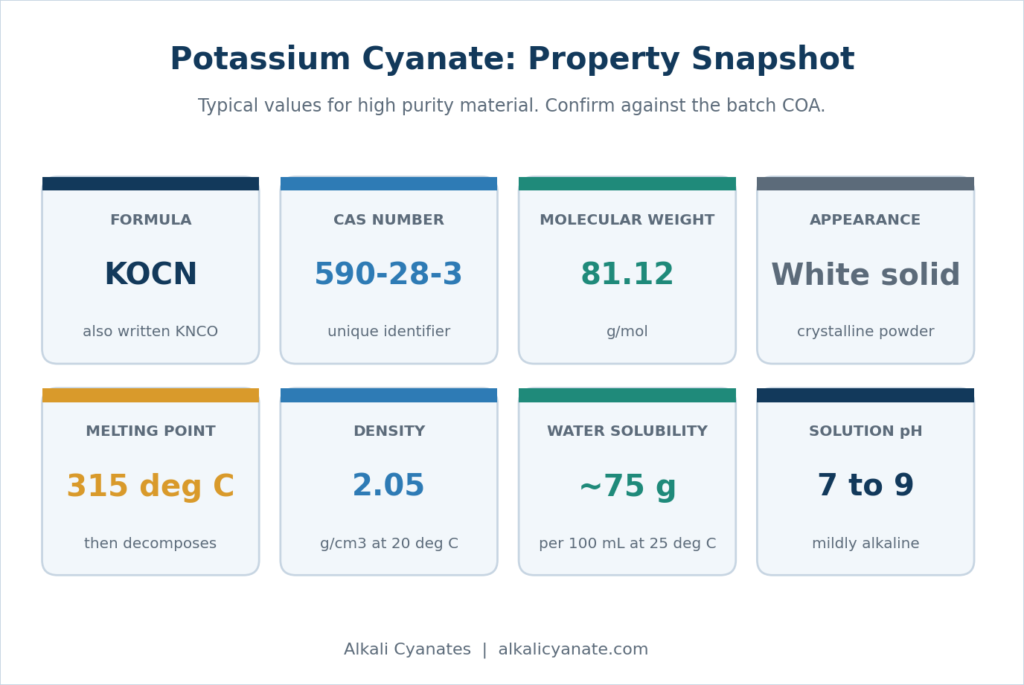
Water solubility is the property that decides most process designs. At 25 °C potassium cyanate dissolves to around 75 g per 100 mL of water, which is high for an inorganic salt of this type. You can build a concentrated aqueous feed without a large water inventory, and that matters when a downstream reactor has volume limits.
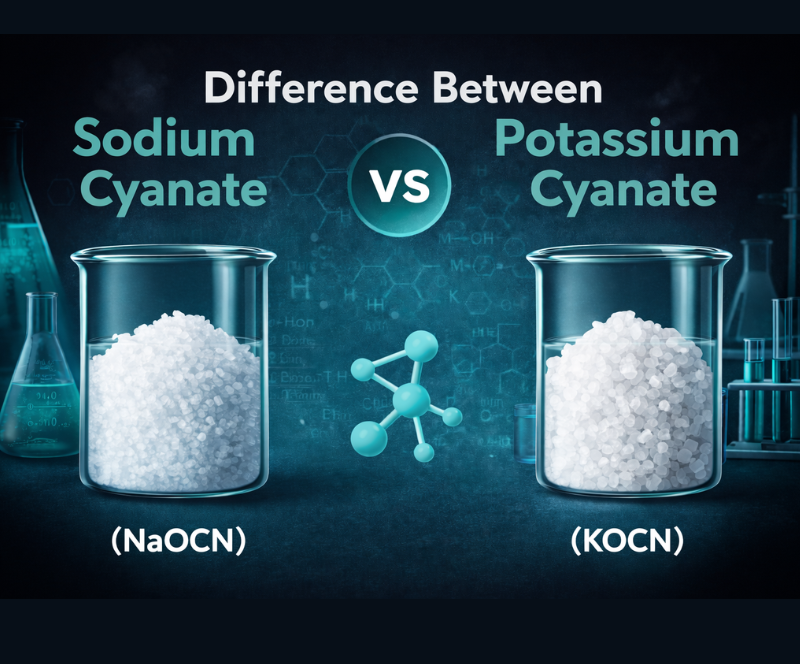
This is where potassium cyanate pulls clearly ahead of its sodium equivalent. Sodium cyanate manages only about 11.6 g per 100 mL at the same temperature, so it needs roughly six times the water volume to carry the same mass of salt. If your process is water-limited, that gap decides the choice on its own.
In organic solvents the picture reverses. Potassium cyanate is slightly soluble in methanol, very slightly soluble in ethanol, and effectively insoluble in acetone, diethyl ether and aromatic hydrocarbons. It dissolves in liquid ammonia, which is occasionally exploited in specialist synthesis but has no bearing on ordinary industrial use.
Does temperature increase potassium cyanate solubility?
Yes, and that creates a trap. Solubility rises as water gets warmer, so heating looks like an easy way to speed up dissolution or push concentration higher. The problem is that hydrolysis speeds up at the same time, and faster than most people expect. You gain a little dissolved salt and lose active cyanate while you do it.
The practical answer is to dissolve at ambient temperature and accept a slightly longer stir time. If a batch genuinely needs warm water, keep it below about 40 °C and use the solution the same shift.
Making up a potassium cyanate solution without losing assay
- Use deionised or softened water at ambient temperature, not hot water from a service line.
- Add the solid to the water under agitation rather than pouring water onto a heap of powder, which cakes.
- Check that the solution sits at pH 8 to 9. Anything drifting acidic will consume cyanate quickly.
- Make up what the shift needs. Solutions held overnight lose strength and start to smell of ammonia.
- Keep carbon dioxide out where you can. Dissolved CO2 acidifies the water and speeds the loss.
Potassium cyanate melting point and thermal behaviour
Potassium cyanate melts at 315 °C. It has no meaningful boiling point because the salt decomposes on stronger heating rather than vapourising. Below the melting point, and kept dry, the crystal is chemically quiet. Nothing much happens to it in an ordinary warehouse.
That 315 °C figure is unusually low for an inorganic salt, and it is the reason cyanates appear in alkali cyanate heat treatment processes. Sodium cyanate melts at 550 °C by comparison. Blend the two and the mixture melts lower than either salt alone, which is what lets salt bath operators run a fluid bath at a workable temperature.
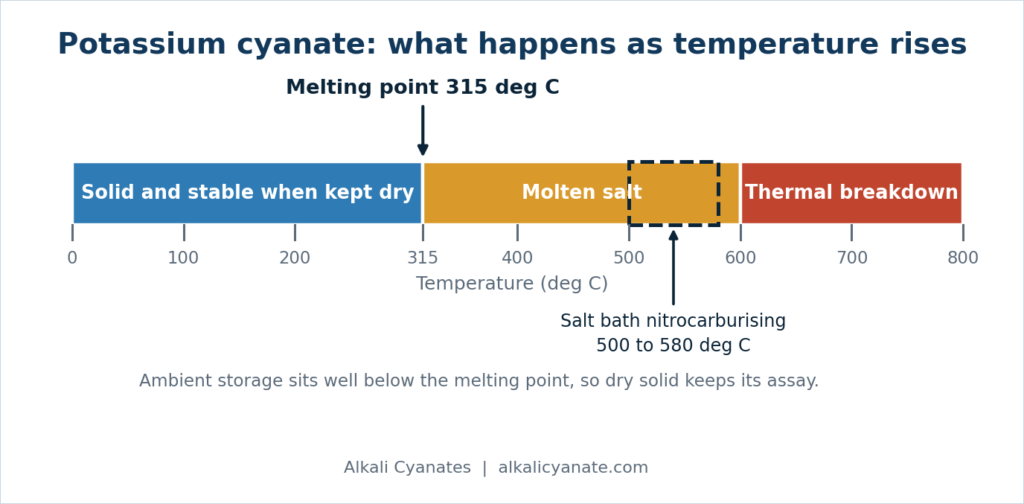
Salt bath nitrocarburising typically runs between 500 and 580 °C. That sits above the melting point, so the bath stays liquid, and below the range where the cyanate itself starts breaking down. Bath chemistry is monitored continuously in practice, because cyanate is consumed during treatment and has to be topped up.
Push the temperature much higher and thermal decomposition sets in. The products depend on atmosphere and what else is present, but the outcome is the same either way: your active cyanate is gone. This is a process control matter, not a storage concern, since no warehouse gets anywhere near these temperatures.
Potassium cyanate stability, hydrolysis and shelf life
Stability is where potassium cyanate surprises people. As a sealed dry solid it is genuinely durable, and a properly stored bag will hold its assay for a year or more. Put it in water and the clock starts running.
The reaction is hydrolysis. Cyanate reacts with water to give ammonia and potassium bicarbonate, consuming the active material as it goes. In neutral water at room temperature this is slow enough to be manageable across a working shift. It is not slow enough to ignore.
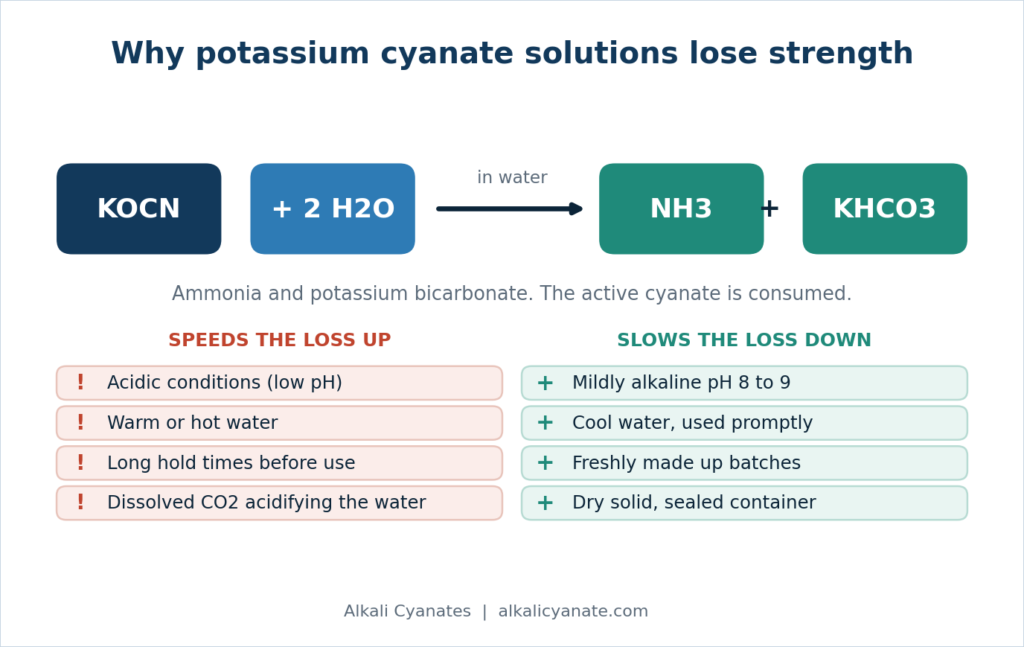
Three factors control how fast this happens. Acidity is the strongest by a wide margin: drop the pH and hydrolysis accelerates sharply, which is why acid contact is the single most damaging thing that can reach this material. Temperature is next, and holding time is third.
The classic warning sign is smell. A potassium cyanate solution that has picked up an ammonia odour has already lost strength, because that ammonia is a hydrolysis product. If an operator reports the smell, the batch needs re-titrating rather than topping up on assumption.
What shelf life should you expect?
Twelve to twenty-four months is the normal expectation for sealed material held in a cool dry store, and that is what we quote against our purity standards. Shelf life is a storage claim rather than a property of the compound, so it only holds if the packaging stays intact. A torn liner in a humid warehouse can undo it in weeks.
What degrades potassium cyanate: incompatibilities to design around
Most assay loss in the field traces back to one of a short list of causes. None of them are exotic. They are the ordinary conditions of a working chemical store.
| Incompatibility | What happens | How to manage it |
| Acids | Rapid hydrolysis of the cyanate, with gas evolution | Segregate acids completely, in a separate bund |
| Moisture and humidity | Caking, then slow assay loss over time | Sealed liners, humidity control, intact packaging |
| Heat | Accelerates every degradation route | Keep the store below 30 °C |
| Strong oxidising agents | Vigorous and potentially hazardous reaction | Store apart, per the safety data sheet |
| Dissolved carbon dioxide | Acidifies solutions and speeds hydrolysis | Cover made-up tanks, use solutions promptly |
| Reducing agents at high temperature | Listed as an incompatibility on safety data sheets | Follow the SDS and keep materials segregated |
Treat the supplier safety data sheet as the controlling document rather than this article. In the UK the handling assessment sits under COSHH, and substance information for the wider regulatory picture is held by ECHA.
Typical potassium cyanate specification
Specifications vary between suppliers and between grades, so the table below is indicative rather than a standard. It reflects what industrial and pharmaceutical buyers commonly ask for. Our full product range covers both tiers.
| Parameter | Technical grade | High purity grade |
| Assay (KOCN) | 96% minimum | 99% minimum |
| Moisture | 0.5% maximum | 0.3% maximum |
| Water insolubles | 0.10% maximum | 0.05% maximum |
| Chloride | 0.2% maximum | 0.05% maximum |
| pH, 5% solution | 7 to 9 | 7 to 9 |
| Appearance | White powder | White free-flowing powder |
| Particle size | As agreed | As agreed |
| Packing | 25 kg HDPE-lined bags | 25 kg HDPE-lined bags or 50 kg drums |
Two lines on that table deserve more attention than they usually get. Moisture is the one that predicts how the material will behave six months into storage, because a wet batch is already hydrolysing slowly in the bag. Water insolubles tell you how the material will behave in a reactor, since insoluble residue ends up as filter load.
If you are comparing tiers, the way we set out cyanate grades explains what the specification differences mean in practice. Buyers running pharmaceutical intermediates generally need the high purity tier; heat treatment and agrochemical work often does not.
Potassium cyanate storage conditions
Storage is not complicated, but it is unforgiving. Everything comes back to keeping the material cool, dry, sealed and well away from acids.
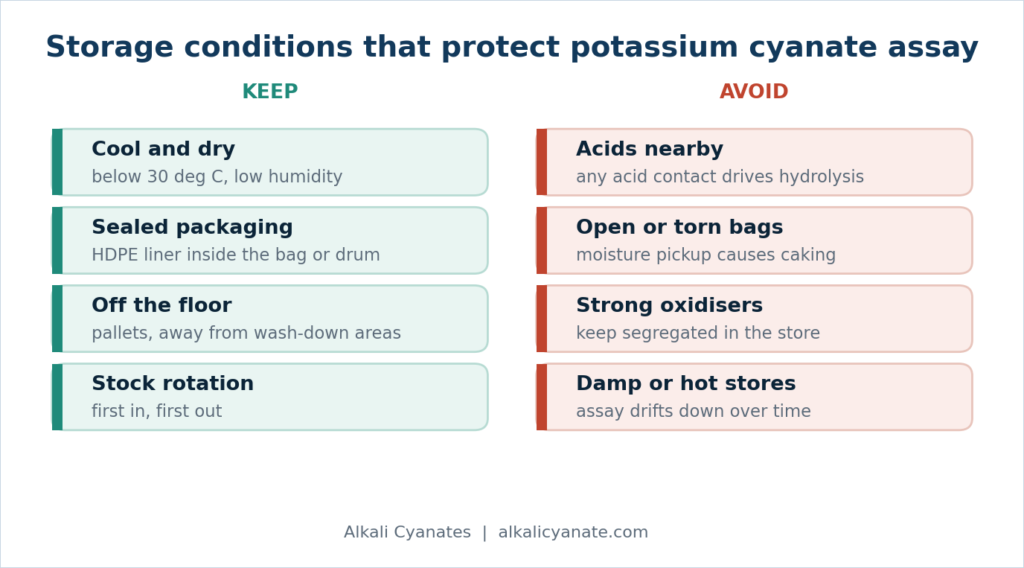
- Store below 30 °C in a dry, well-ventilated area, out of direct sunlight.
- Keep the inner HDPE liner sealed. Reseal after part-use rather than folding the bag over.
- Palletise and keep stock off the floor, away from wash-down zones and drains.
- Segregate from acids and strong oxidising agents, ideally in a separate bund.
- Run first in, first out. Old stock at the back of a store is how assay drift goes unnoticed.
- Handle with gloves, eye protection and adequate ventilation, following the safety data sheet.
Anyone importing into the UK or EU should also confirm the registration position before the order ships, since that sits under REACH rather than the supplier specification.
How potassium cyanate properties drive its uses
Properties only matter when they change what the material can do. Each row below links a physical or chemical characteristic to the application it enables.
| Property | Why it matters | Where it is used |
| High water solubility | Concentrated aqueous feeds without large water volumes | Agrochemical and pharmaceutical synthesis |
| Melting point of 315 °C | Forms a workable molten salt below red heat | Salt bath nitrocarburising and heat treatment |
| Reactive cyanate ion | Reacts with amines to build urea and carbamate structures | Semicarbazide, urea derivatives, dye intermediates |
| Mild alkalinity in solution | Sits comfortably in buffered aqueous systems | Textile auxiliaries and process chemistry |
| Free-flowing white powder | Accurate weighing and clean charging | Batch reactor operations |
| Low toxicity relative to cyanide | Far simpler regulatory and handling burden | General industrial use worldwide |
If you want the wider background rather than the numbers, our explainer on what potassium cyanate is covers production, history and end markets in more depth.
Potassium cyanate vs sodium cyanate: which properties differ
These two salts are chemically similar and often substitutable, but the numbers separate them clearly enough to make the choice straightforward.
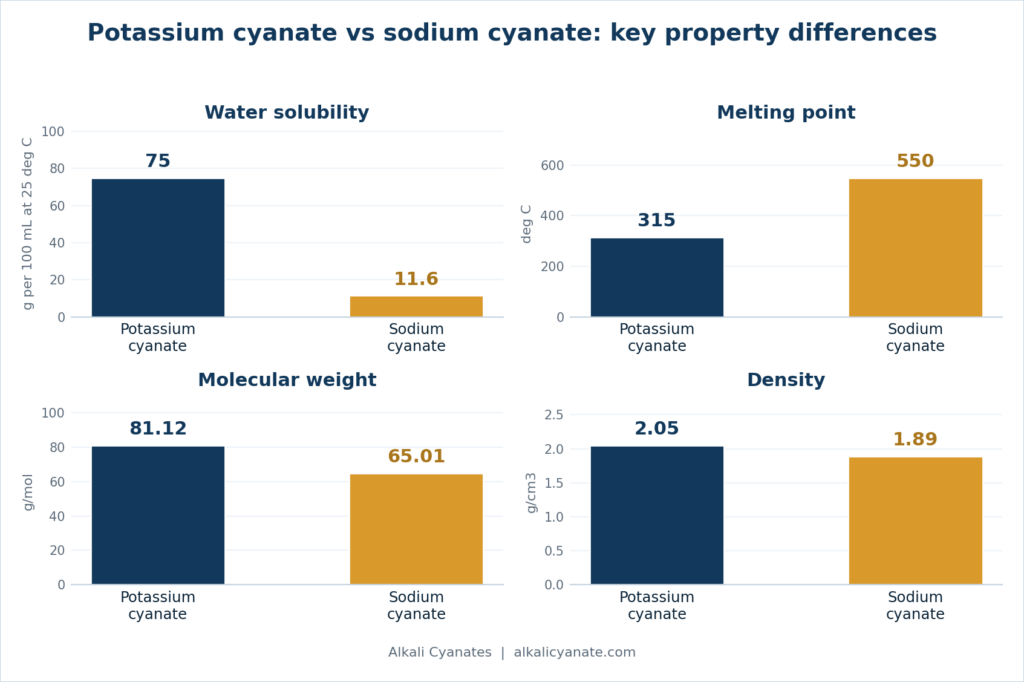
| Property | Potassium cyanate | Sodium cyanate |
| Formula | KOCN | NaOCN |
| CAS number | 590-28-3 | 917-61-3 |
| Molecular weight | 81.12 g/mol | 65.01 g/mol |
| Melting point | 315 °C | 550 °C |
| Water solubility at 25 °C | About 75 g per 100 mL | About 11.6 g per 100 mL |
| Density | 2.05 g/cm3 | 1.89 g/cm3 |
| Cyanate content per kg | Lower, heavier cation | Higher, lighter cation |
| Relative cost | Higher | Lower |
Choose potassium cyanate when you need a concentrated aqueous solution, when the process is water-limited, when a low melting point is useful, or when the potassium ion itself is required by the chemistry. Choose sodium cyanate when cost per mole of cyanate is the deciding factor, since the lighter cation delivers more cyanate per kilogram at a lower price.
Our side-by-side on sodium cyanate vs potassium cyanate goes further into the commercial trade-offs, including freight and packaging economics for export orders.
Is potassium cyanate the same as potassium cyanide?
No. They are different compounds with different formulae, different CAS numbers and vastly different hazard profiles. The names sit one letter apart, which causes real confusion in procurement systems, but nothing else about them matches.
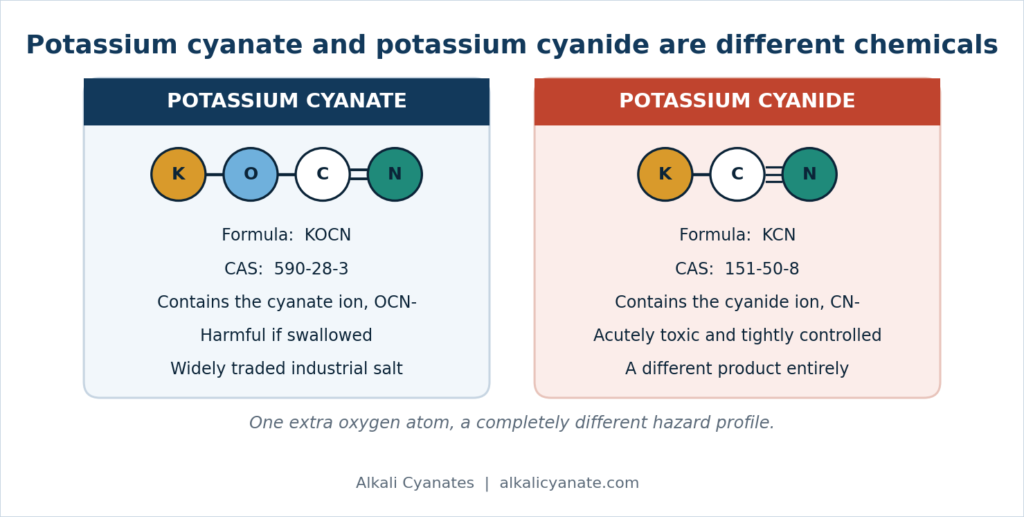
Potassium cyanate is KOCN, CAS 590-28-3, and contains the cyanate ion OCN-. It is classified as harmful if swallowed and is handled with routine chemical precautions. Potassium cyanide is KCN, CAS 151-50-8, contains the cyanide ion CN-, and is acutely toxic and tightly controlled almost everywhere.
The oxygen atom is the difference, and it changes everything about how the material is regulated, shipped and handled. We wrote a fuller piece on how cyanates and cyanides differ because the question comes up in almost every first enquiry we receive.
What to check before you buy potassium cyanate
Property data only helps if the material in the drum matches it. These are the checks that separate a reliable supply from an expensive surprise.
- A batch-specific certificate of analysis, not a generic specification sheet reprinted for every order.
- The stated assay method, so you can reconcile your incoming test against the supplier result.
- Moisture content, which predicts how the material will hold up through storage and transit.
- Packaging detail, specifically the inner liner, since that is what protects assay in a humid container.
- Regulatory documentation for your destination market, including registration status where it applies.
- A pre-shipment sample for any first order or any change in grade.
Export buyers have an extra consideration. Lead time, container loading and documentation all differ by route, and our guides for buyers in the USA and buyers in Canada set out what to expect on each.
Sourcing potassium cyanate from Alkali Cyanates
We manufacture and export alkali cyanates from Ahmedabad, India, and potassium cyanate is one of our two core products alongside sodium cyanate. Orders ship to industrial and pharmaceutical buyers across North America, Europe, the Middle East and Southeast Asia.
What buyers tend to raise with us first is consistency rather than headline purity.
Anyone can hit 99% on a good batch. Holding it across twelve consecutive shipments, with the same moisture figure and the same particle size distribution, is the harder problem, and it is the one that determines whether your process runs the same way every month.
Every consignment ships with a batch certificate of analysis and the documentation your destination market requires. If you want to discuss grade selection, packing or lead times for a specific application, talk to our technical team, or read how we handle importing potassium cyanate from India.
Frequently asked questions
What is the melting point of potassium cyanate?
Potassium cyanate melts at 315 °C. It has no usable boiling point because the salt decomposes on stronger heating rather than vapourising. For comparison, sodium cyanate melts at 550 °C.
How soluble is potassium cyanate in water?
Potassium cyanate dissolves in water at approximately 75 g per 100 mL at 25 °C. That is roughly six times more soluble than sodium cyanate, which manages about 11.6 g per 100 mL at the same temperature.
Is potassium cyanate soluble in ethanol?
Only very slightly. Potassium cyanate is slightly soluble in methanol, very slightly soluble in ethanol, and effectively insoluble in acetone, diethyl ether and aromatic hydrocarbons. It is a water-soluble salt and little else.
What is the molecular weight of potassium cyanate?
The molecular weight of potassium cyanate is 81.12 g/mol, calculated from potassium at 39.10, carbon at 12.01, nitrogen at 14.01 and oxygen at 16.00.
Is potassium cyanate stable?
As a dry solid in sealed packaging, yes. It typically holds its assay for 12 to 24 months when stored cool and dry. In water it hydrolyses steadily to ammonia and potassium bicarbonate, and acid or heat accelerates that considerably.
What is the CAS number for potassium cyanate?
The CAS number for potassium cyanate is 590-28-3. Potassium cyanide is a different chemical with the CAS number 151-50-8.
Is potassium cyanate the same as potassium cyanide?
No. Potassium cyanate (KOCN) contains the cyanate ion and is classified as harmful if swallowed. Potassium cyanide (KCN) contains the cyanide ion and is acutely toxic and tightly controlled. The single extra oxygen atom changes the hazard profile entirely.
How should potassium cyanate be stored?
Store below 30 °C in a dry, well-ventilated area with the inner HDPE liner sealed. Keep it palletised and off the floor, segregated from acids and strong oxidising agents, and rotate stock first in, first out.
Why does my potassium cyanate solution smell of ammonia?
Ammonia is a hydrolysis product. The smell means the cyanate has started reacting with water, so the solution has already lost strength. Re-titrate the batch rather than assuming the original concentration still holds.
What is the appearance of potassium cyanate?
Potassium cyanate is supplied as a white to off-white crystalline powder or fine granules. It is odourless when dry. Yellowing or caking usually points to moisture ingress or contamination.
What is potassium cyanate used for?
Its main uses are agrochemical and pharmaceutical synthesis, salt bath nitrocarburising in heat treatment, and the manufacture of urea derivatives, semicarbazide and dye intermediates.
Is potassium cyanate hazardous?
It is classified as harmful if swallowed and can irritate eyes, skin and the respiratory tract. It is far less hazardous than cyanide salts, but it still requires gloves, eye protection and ventilation. Always work from the supplier safety data sheet.