

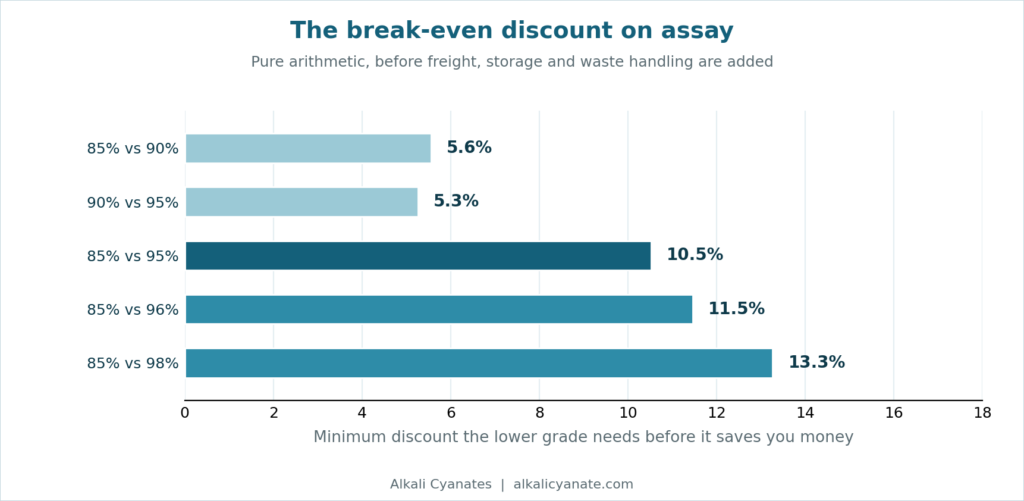
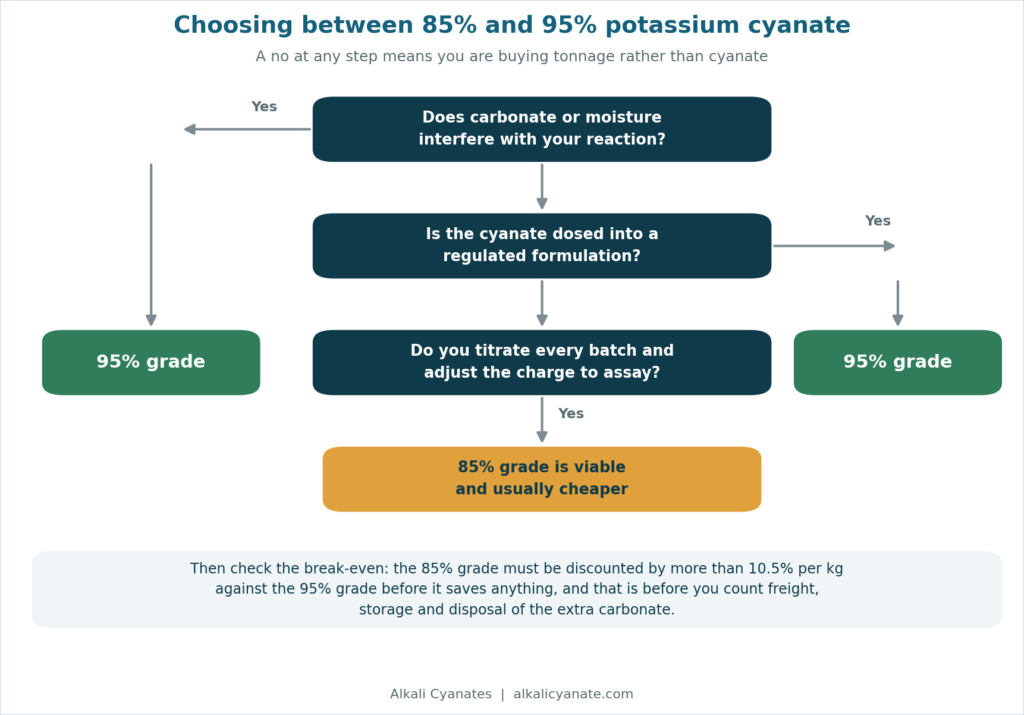
Most buyers need the 85% technical grade. The exception is any process where the balance of the product gets in the way. The other 15% is mostly potassium carbonate, plus moisture and a little chloride, and in a carbamylation step or a dosed pharmaceutical intermediate that balance moves your pH, drags your yield and shows up in your impurity profile. In a nitrocarburising salt bath it barely registers, because carbonate builds up in the bath during service anyway. Before you switch on price alone, run one number: the 85% grade has to be more than 10.5% cheaper per kilogram than the 95% grade before it saves you anything.
What the percentage on a potassium cyanate spec sheet actually measures
The number is an assay. It is the weight of potassium cyanate, KOCN, in a kilogram of the material you receive. It is not a general statement about cleanliness, and it says nothing on its own about which impurities make up the remainder.
That distinction matters more than most spec sheets let on. Two suppliers can both quote 85% and ship materially different products, because one is carrying 12% carbonate and half a percent of everything else, while the other is carrying 8% carbonate, 3% moisture and enough chloride to matter in a chloride-sensitive step.
Potassium cyanate is usually made by reacting urea with potassium carbonate at temperature. Carbonate is the starting material and the hydrolysis product, so residual carbonate is the normal signature of the process rather than a sign of a careless one. Refining it out is what separates a technical grade from a high purity grade, and it costs money at every stage.
The other thing to check is how the assay was measured. A titrimetric result and an ion chromatography result on the same drum can differ by a point or more, which is enough to move you across a specification boundary. If your incoming QC titrates and your supplier reports by IC, agree the method before the first shipment rather than after the first rejection.
Potassium cyanate 85%: what you are buying
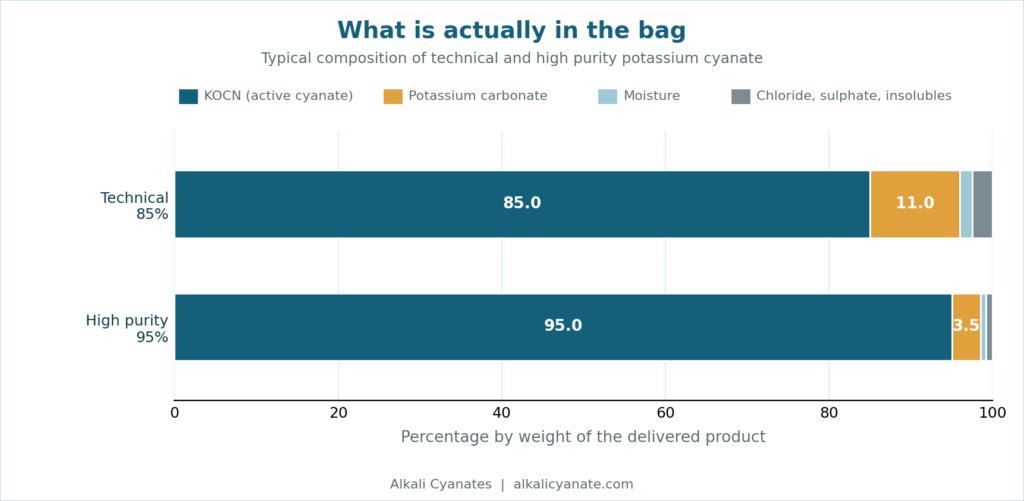
A technical 85% grade is a free-flowing white to off-white powder with roughly 11% potassium carbonate, around 1% to 2% moisture and a small remainder of chloride, sulphate and water insolubles. It dissolves readily, it handles well, and for a large share of industrial demand it does everything the 95% grade does at a lower price per tonne.
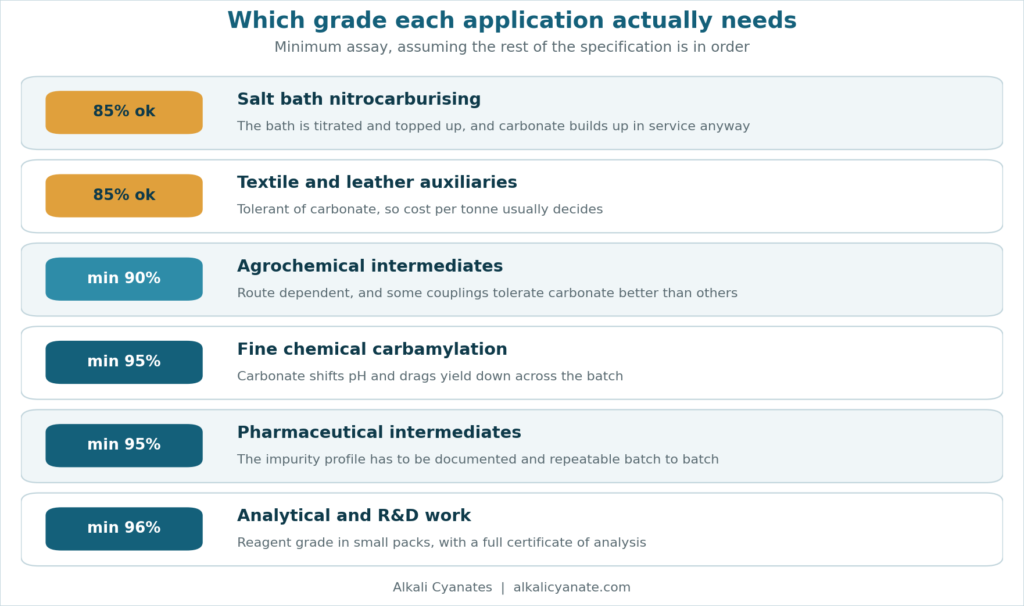
It suits processes that are tolerant of alkalinity and are controlled by measurement rather than by charge weight. Salt bath heat treatment processes are the clearest example. The bath is titrated on a schedule and topped up against the reading, so the carbonate that arrives with the cyanate joins carbonate that the bath generates on its own. Buying a purer input does not buy you a cleaner bath.
Textile and leather auxiliary work sits in the same category. So do a number of agrochemical intermediate routes, though that one depends heavily on the specific coupling. If you are running an aqueous step at high pH and you titrate before you charge, the technical grade is usually the sensible commercial choice.
The weakness of the 85% grade is variability rather than the headline number. A supplier working to a minimum of 85% may ship 85.4% one month and 89% the next, both entirely within specification. If your process compensates by measurement that is fine. If your process assumes a fixed charge weight, that swing lands in your yield.
Potassium cyanate 95%: where the extra ten points earn their keep
A 95% grade typically carries around 3% to 4% carbonate, under 1% moisture and tighter limits on chloride, sulphate and insolubles. Reagent grades sold in laboratory packs go further again, commonly to 96% or 97%, with a full impurity panel.
The obvious benefit is that you get more cyanate per kilogram. The benefit that actually justifies the premium is narrower variation. A tighter specification means a narrower band around the target, and a narrower band means your charge calculation holds from batch to batch without a titration in front of every run.
Three situations call for it. Carbonate that shifts reaction pH and costs you yield is the first. A regulated formulation where every impurity has to be identified and reported is the second. Processes with no in-line assay step, where the charge weight is fixed in the batch record and nobody checks the drum, are the third.
There is a fourth case that has nothing to do with chemistry. If you are shipping across an ocean and paying freight by weight, you are paying to move carbonate. On long routes the freight differential eats into the price advantage of the technical grade before the material reaches your gate.
Potassium cyanate 85% and 95% side by side
The table below sets out typical values. Treat them as a starting point for your enquiry rather than as a specification, because every manufacturer works to a slightly different internal standard.
| Parameter | Technical 85% | High purity 95% |
| Assay (KOCN) | 85% minimum | 95% minimum |
| Potassium carbonate | Around 10% to 12% | Around 3% to 4% |
| Moisture | 1% to 2% | Below 1% |
| Chloride and sulphate | Present, often unquantified | Quantified and limited |
| Water insolubles | Higher, matters for dosing lines | Low |
| Batch-to-batch variation | Wider band above the minimum | Narrow band above the minimum |
| Typical appearance | White to off-white powder | White free-flowing powder |
| Common pack sizes | 25 kg and 50 kg lined bags or drums | 25 kg lined drums, smaller packs on request |
| Best suited to | Salt baths, textile auxiliaries, tolerant intermediates | Fine chemicals, pharma intermediates, dosed formulations |
Which grade each application actually needs
Salt bath nitrocarburising and heat treatment
Cyanate content in the bath is the controlled variable, and it is measured directly. Technical grade is standard here, and paying for 95% is paying for something the bath immediately dilutes. What does matter is water insolubles, because they accumulate as sludge and shorten the interval between bath cleanouts.
Agrochemical and herbicide intermediates
This one splits. Routes that run in strong alkali and tolerate carbonate can take the technical grade without complaint. Routes where the cyanate is the limiting reagent in a controlled-pH step usually want 90% or better, and some want 95%. Ask your process chemist where the pH sits at the point of addition, not where it sits at the start.
Fine chemicals and carbamylation
Carbamylation chemistry is sensitive to pH and to competing hydrolysis. Carbonate pushes the pH up and accelerates the side reaction you are trying to suppress, so the yield loss from a technical grade often exceeds the money saved on the drum. This is the application where buyers most frequently regret trading down.
Pharmaceutical intermediates
Assay is almost beside the point here. What matters is that every impurity is identified, quantified and stable across batches, and that the manufacturer can produce the same certificate twelve months from now. A 95% grade with a documented panel beats a 96% grade with a vague one.
Laboratory and development work
Buy reagent grade in small packs. The cost difference across a few hundred grams is trivial, and an unexplained result caused by carbonate in your starting material will cost you a week.
The arithmetic most buyers skip
Comparing grades on price per kilogram compares two different things, because a kilogram of the 85% grade contains 0.85 kg of cyanate and a kilogram of the 95% grade contains 0.95 kg. Convert both to a price per kilogram of contained KOCN and the comparison becomes honest.
The break-even is fixed by the ratio of the two assays. An 85% grade has to be discounted by more than 10.5% against a 95% grade before it saves a single rupee, and that is before you count anything else.
A worked example
Take a plant that needs 10 tonnes of contained potassium cyanate. The 95% grade is quoted at 1,000 per tonne and the 85% grade at 900 per tonne, a 10% discount that sits just under the break-even. Freight and handling run at 60 per tonne on both. Currency is irrelevant, the ratios are what matter.
| Line | 85% grade | 95% grade |
| Contained KOCN required | 10.00 t | 10.00 t |
| Product tonnage to buy | 11.76 t | 10.53 t |
| Material cost | 10,588 | 10,526 |
| Freight and handling at 60/t | 706 | 632 |
| Delivered cost | 11,294 | 11,158 |
| Carbonate carried through the plant | 1.29 t | 0.37 t |
A 10% headline discount ends up costing 136 more, and it drags almost a tonne of extra carbonate through the plant. That carbonate occupies warehouse space, consumes acid if you neutralise it, and leaves as effluent.
None of this argues against technical grade. It argues against buying it at the wrong discount. If your supplier prices the 85% material 18% or 20% below the 95% material and your process tolerates carbonate, the technical grade is comfortably the better buy. The point is to check rather than assume.
A three-question test for choosing a grade
Most grade decisions come down to three questions about the process rather than the product. Work through them in order and the answer is usually obvious.
The impurities that matter more than the headline number
Potassium carbonate is the big one. It raises pH in solution, it consumes acid if you neutralise, and it is the main reason a technical grade behaves differently in a sensitive reaction.
Moisture is the one that quietly changes over time. Cyanate hydrolyses slowly in the presence of water, so a high moisture content at despatch means a lower assay at the point of use. It also causes caking, which is a nuisance in any automated dosing line.
Chloride and sulphate come from the raw materials and rarely appear on a technical grade certificate at all. They matter if you are working near stainless steel at temperature, or if your downstream product has a chloride limit.
Water insolubles are the parameter buyers ignore until a bath sludges or a filter blinds. Ask for the number even when the application seems tolerant.
Heavy metals only matter for pharmaceutical, food chain and some agrochemical work, but where they matter they matter absolutely. Ask for named elements with limits rather than a single combined figure.
How to read a potassium cyanate certificate of analysis
A certificate that lists only an assay figure and a batch number is a marketing document. A useful one lets you reproduce the result and trace the batch.
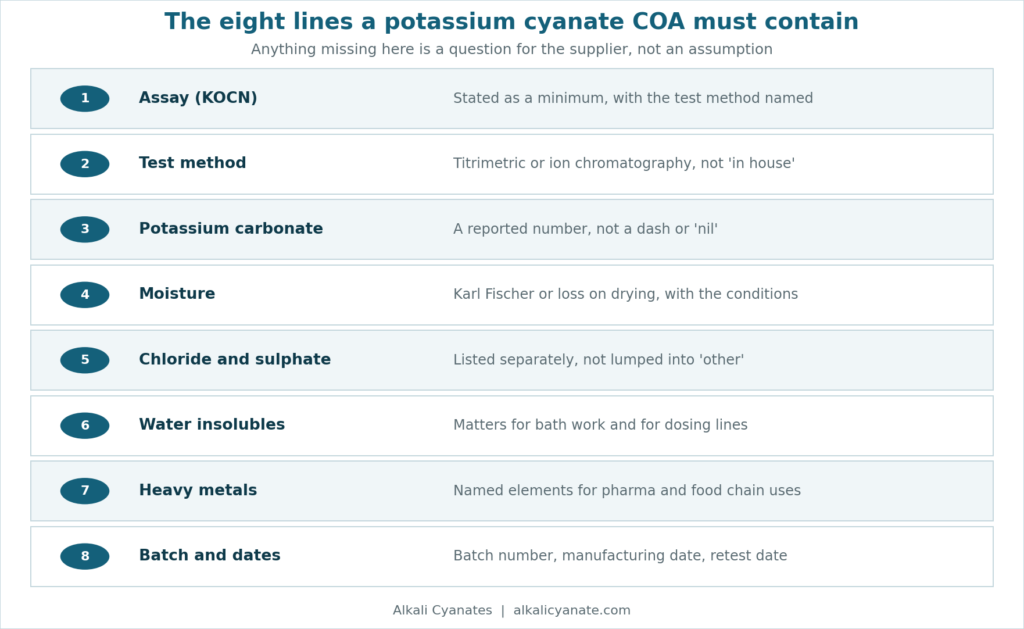
The same logic applies across the family. If you are also buying sodium cyanate, the sodium cyanate purity standards follow a comparable structure, and the trade-offs between grades run the same way.
Storing the grade you paid for
Assay is a property of the material at the moment it is tested, not a permanent attribute of the drum. Potassium cyanate reacts slowly with atmospheric moisture to give ammonia and potassium carbonate, which means a certificate issued eight months ago describes a product that no longer quite exists.
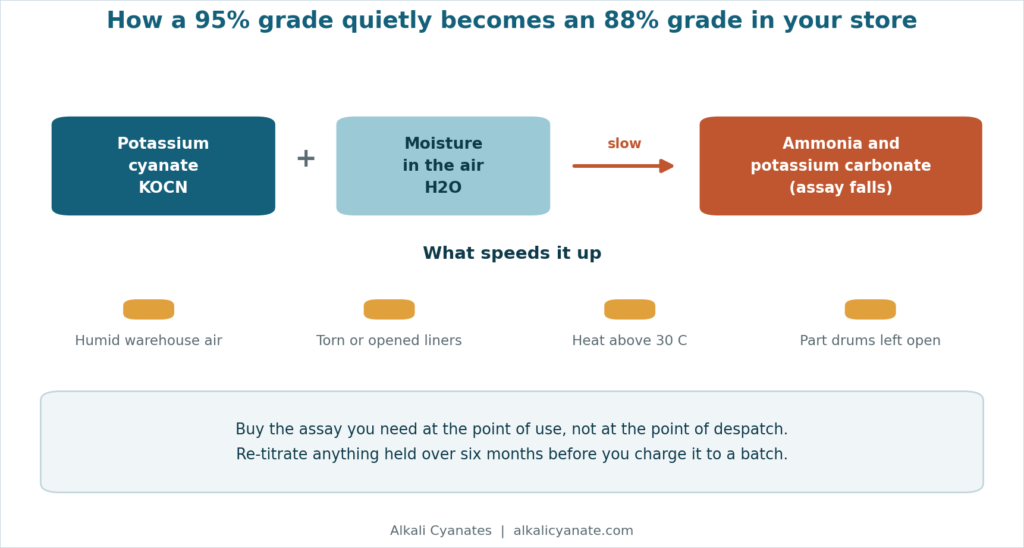
Keep it in the original lined packaging, sealed, in a dry store below 30 degrees Celsius. Reseal part-used drums the same day. Rotate stock properly, because the drum at the back of the rack is the one that will let you down.
On handling, treat it as an irritant to skin, eyes and the respiratory tract, and keep it away from acids and strong oxidising agents. Contact with acid liberates ammonia and carbon dioxide. Your own risk assessment and the current safety data sheet take precedence over anything written here, and we send a current sheet with every consignment.
Questions worth asking before you place the order
These are the questions that separate a supplier who understands the product from one who is reselling drums.
- Is the assay a minimum or a typical value, and what is the historical spread above it?
- Which method was used, titrimetric or ion chromatography, and will you report the same way every time?
- What is the carbonate content, as a number rather than a dash?
- What is the moisture content, and by which method?
- What is the manufacturing date, and what retest interval do you apply?
- Can you hold the same specification across repeat orders for the next twelve months?
- What packaging and liner do you use, and is it suitable for a humid destination?
- Can you send a pre-shipment sample from the actual production batch?
Ordering potassium cyanate from Alkali Cyanates
We manufacture and export both grades from Ahmedabad, and we would rather sell you the correct one than the expensive one. Our potassium cyanate product page carries the current specifications for the technical and high purity grades, and the full product range covers sodium cyanate alongside it.
If you are still working out which compound suits the process, the comparison of sodium cyanate against potassium cyanate is the better starting point, and our primer on what potassium cyanate is covers the chemistry from the beginning.
We ship in 25 kg and 50 kg lined packaging with a certificate of analysis against every batch, and we send pre-shipment samples on request. Buyers in North America can read the detail on supply into the USA and Canada, and there is a separate guide to importing potassium cyanate from India covering documentation and lead times.
Send us your application, your tolerance for carbonate and your annual volume, and we will quote the grade that fits rather than the grade with the best margin. Request a quote and we will come back with a specification and a sample.
Frequently asked questions
Is 85% potassium cyanate the same as technical grade?
In most catalogues, yes. Technical grade describes the intended use rather than a fixed number, and 85% is the common commercial floor for it. Some manufacturers sell a technical grade at 90% or 92%, so always buy against the assay figure rather than the word.
What is the other 15% in an 85% potassium cyanate?
Mostly potassium carbonate, typically 10% to 12%, left over from the manufacturing route. The remainder is moisture at 1% to 2%, with small amounts of chloride, sulphate and water insolubles. It is not inert filler, and the carbonate in particular changes how the material behaves in solution.
Can I use 95% potassium cyanate where 85% is specified?
Almost always, but check your charge calculation first. If the batch record was written around an 85% assay and you swap in 95% at the same weight, you have increased the cyanate charge by about 12%. Adjust the weight, or adjust the record.
Does potassium cyanate lose assay in storage?
Yes, slowly, through hydrolysis with atmospheric moisture. Sealed original packaging in a dry store below 30 degrees Celsius holds it well for a long time. Torn liners, part-used drums and humid warehouses accelerate the loss noticeably, so re-titrate anything held over six months.
How is potassium cyanate assay tested?
Usually by titration after controlled acid hydrolysis, or by ion chromatography for a more precise result. The two methods can differ by a point or more on the same sample, which is why the certificate should always name the method used.
Is potassium cyanate the same as potassium cyanide?
No. They are different compounds with very different properties. Potassium cyanate is KOCN, an industrial salt handled as an irritant under normal chemical controls. Potassium cyanide is KCN and is acutely toxic. The names differ by two letters and the substances do not resemble each other in handling, regulation or hazard.
Which grade is used in salt bath nitrocarburising?
Technical grade, normally 85%. The bath is titrated on a schedule and topped up against the reading, and carbonate accumulates during service regardless of what you charge, so a higher assay input buys very little. Water insolubles matter more than assay in this application.
What pack sizes and lead times apply to bulk orders?
We supply 25 kg and 50 kg moisture-barrier lined bags and drums as standard, with palletised and container loads for volume buyers. Lead times depend on grade and destination, so send your requirement through the contact page for a current quotation.