

Most sodium cyanate suppliers will take a bulk order from around 500 kg, and a genuine commercial order usually starts at 5 tonnes. Standard export packaging is 25 kg or 50 kg HDPE or paper bags with an inner liner, or 500 kg to 1,000 kg FIBC jumbo bags for larger volumes. Lead time is typically 10 to 15 days ex-works from an Indian plant, and roughly six weeks door to door once ocean freight and customs are included. The rest of this guide breaks down what moves those numbers, and what to put in your enquiry so the quotation comes back the same week.
What counts as a bulk sodium cyanate order?
There is no industry-wide definition, which is why quotations vary so much. In practice, suppliers sort enquiries into four bands, and the band you fall into decides your price, your packaging and how quickly you get an answer.
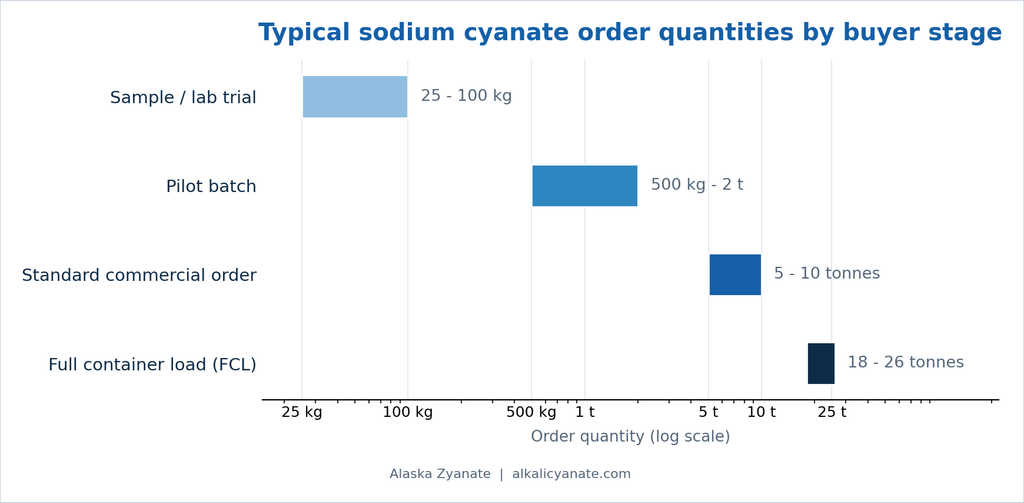
| Order band | Typical quantity | Usual packaging | What it is for |
| Sample | 25 kg to 100 kg | 25 kg bag | Lab qualification and trial runs |
| Pilot batch | 500 kg to 2 tonnes | 25 kg or 50 kg bags | Process validation on a live line |
| Standard commercial | 5 to 10 tonnes | 50 kg bags on pallets | Ongoing production, part container |
| Full container load | 18 to 26 tonnes | 50 kg bags or FIBC | Best landed cost per tonne |
Anything at or above the pilot band is treated as a sodium cyanate bulk order and priced on a per-tonne basis rather than a list price. Below that, you are buying a sample, and the cost per kilo will look alarming by comparison.
Sodium cyanate MOQ: what actually sets the minimum
A supplier’s minimum order quantity is rarely arbitrary. It comes from batch economics, packing line setup and freight. Five things move it:
- Grade. A standard 90% industrial grade is usually held in stock. A higher purity grade may be made to order, which raises the minimum to a full batch.
- Packaging format. FIBC jumbo bags are filled in 500 kg or 1,000 kg units, so ordering 1.2 tonnes in jumbo bags makes no sense. Bags give you finer granularity.
- Destination and route. A part-container shipment to Rotterdam is straightforward. The same tonnage to an inland US site can cost more in handling than the goods are worth below a few tonnes.
- Order history. Repeat buyers are often accommodated below the published MOQ because the specification and paperwork are already settled.
- Container economics. Once you pass roughly 18 tonnes you are paying for a container either way, so the marginal cost of filling it is close to nil. This is why buying sodium cyanate in bulk at FCL volumes lands so much cheaper per tonne.
One practical note from our own order book: buyers who ask for 2 tonnes in 25 kg bags almost always end up switching to 50 kg bags on the second order. The handling saving is obvious once the first pallet is opened.
Sodium cyanate packaging options for bulk shipments
Sodium cyanate is a white, free-flowing powder that is highly soluble in water, so packaging exists to keep moisture out as much as to move weight. Three formats cover almost every export order.
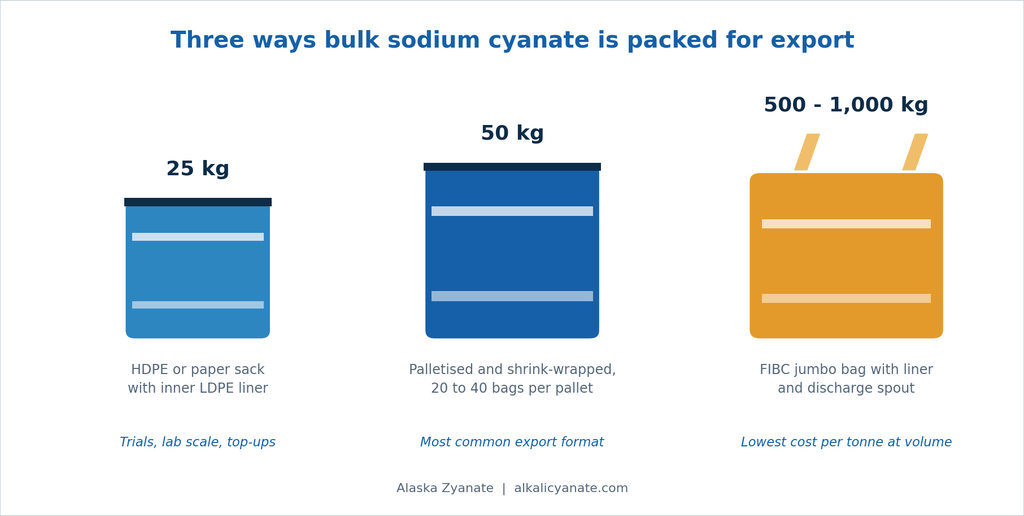
| Format | Net weight | Construction | Best for | Handling |
| Paper or HDPE sack | 25 kg | Multi-wall with inner LDPE liner | Trials, small top-up orders | Manual, no equipment needed |
| Paper or HDPE sack | 50 kg | Multi-wall with inner LDPE liner | Most part-container orders | Palletised, forklift or pallet truck |
| FIBC jumbo bag | 500 kg | Woven PP with liner and spout | Mid-size continuous users | Forklift or hoist, discharge to hopper |
| FIBC jumbo bag | 1,000 kg | Woven PP with liner and spout | Full container loads | Forklift or hoist, lowest cost per tonne |
What goes inside the bag matters more than the bag
Ask any supplier to confirm the inner liner gauge and the sealing method. A polyethylene liner heat-sealed inside a woven outer keeps the powder free-flowing through a monsoon transit and a European winter. A stapled paper sack with no liner will not, and you will find out at the point of discharge.
For sea freight we also recommend a desiccant sachet inside each FIBC on routes with long transits or repeated temperature swings. It costs very little and it removes the most common quality complaint on arrival, which is caking rather than assay drift.
Palletisation and how much fits in a container
A standard 20 ft dry container has a maximum payload of around 28,200 kg, but you will never load that with bagged product. Pallet weight, dunnage and the practical limit of a single tier bring the realistic figure down.
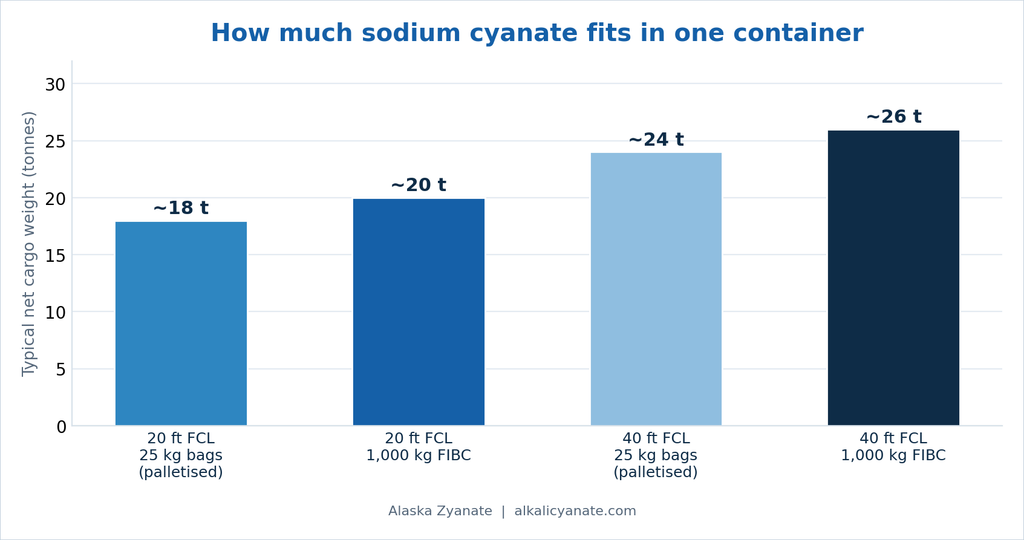
The pattern is consistent. Jumbo bags win on weight per container, bags win on flexibility, and a 40 ft container rarely doubles your payload because you hit the weight limit long before you run out of floor space.
Sodium cyanate lead times: a realistic timeline
Suppliers quote lead time in two different ways, and the gap between them causes most of the friction on a first order. Ex-works lead time is how long until the goods are ready at the plant. Door-to-door lead time includes freight and customs at both ends.
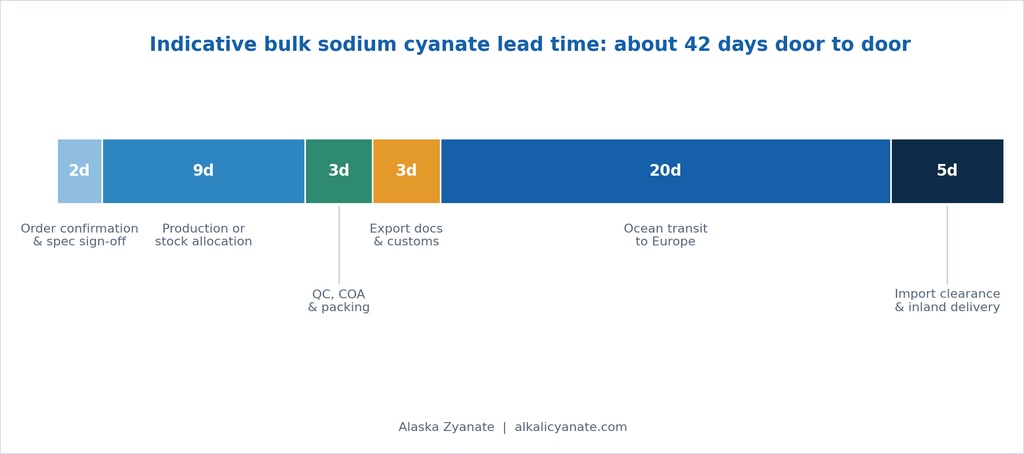
Ocean transit is the biggest single block and the one nobody controls. Sailings from Nhava Sheva to Rotterdam typically run 18 to 22 days, with Mundra a day or two quicker and Chennai a few days slower.
| Destination | Ex-works ready | Ocean transit | Indicative door to door |
| Northern Europe (Rotterdam, Hamburg) | 10 to 15 days | 18 to 22 days | 6 to 7 weeks |
| UK (Felixstowe, Southampton) | 10 to 15 days | 20 to 24 days | 6 to 8 weeks |
| US East Coast | 10 to 15 days | 28 to 35 days | 8 to 10 weeks |
| Middle East (Jebel Ali) | 10 to 15 days | 5 to 8 days | 3 to 4 weeks |
| Southeast Asia | 10 to 15 days | 10 to 16 days | 4 to 6 weeks |
If you are buying into the United States or Canada, build the longer transit into your reorder point rather than into your safety stock. It is cheaper to order earlier than to hold more.
What makes a lead time slip
- Specification changes after the order is confirmed. A revised assay or a different loss-on-drying limit sends the batch back to the queue.
- Late payment or a delayed letter of credit. Production usually starts on receipt of the advance, not on receipt of the purchase order.
- Label and marking approvals. Buyers who need their own artwork on the bag should send it with the order, not after it.
- Port congestion and blank sailings, which have been a recurring feature of the Europe trade lanes and are worth a buffer of a week.
Grades and specification: settle this before you order
Sodium cyanate is NaOCN, CAS number 917-61-3, with a molar mass of 65.01 g/mol and a melting point of 550 degrees C. Commercially it is sold in two main industrial grades, and the difference is soda ash content rather than anything exotic.
| Parameter | 90% industrial grade | 96% grade |
| Assay (NaOCN) | 90.00% minimum | 96.00% minimum |
| Sodium carbonate | 10.00% maximum | 4.00% maximum |
| Loss on drying at 110 C | 0.50% maximum | 0.50% maximum |
| Appearance | White free-flowing powder | White free-flowing powder |
| pH, 5% solution | 10.0 to 11.0 | 10.0 to 11.0 |
| Typical use | Salt bath heat treatment, agrochemical intermediates | Fine chemical and pharmaceutical intermediates |
Laboratory suppliers list material at 97.5% assay and above in 100 g and 1 kg packs, which is a different product class and a different price. For production volumes, the 90% and 96% grades are what the market runs on. Our sodium cyanate purity standards guide sets out how each figure is tested.
Two clarifications that come up on almost every first enquiry. Sodium cyanate is not sodium cyanide, and the two are governed by completely different rules, as our comparison of sodium cyanate and sodium cyanide explains. If your process is a salt bath, also check whether potassium cyanate suits it better.
Documents that should arrive with a bulk shipment
A complete document set is the clearest signal that you are dealing with an established exporter rather than a trading intermediary. For a bulk sodium cyanate shipment out of India, expect all of the following:
- Batch-specific certificate of analysis, tested against the agreed specification rather than a generic typical analysis.
- Safety data sheet in the format your region requires, with the GHS classification stated in section 2 and transport classification in section 14.
- Commercial invoice and packing list, showing net and gross weight per pallet or FIBC.
- Bill of lading or air waybill, plus the certificate of origin where your customs authority requires one.
- Insurance certificate on CIF terms, and fumigation or non-wood packing declaration where pallets are used.
On classification, sodium cyanate carries a harmonised EU classification of harmful if swallowed and harmful to aquatic life with long lasting effects, and it is registered under REACH in the 100 to 1,000 tonnes per annum band. That REACH status matters if you are importing into the EU, so raise it early.
Incoterms and how a bulk quotation is built
Comparing two quotations on price alone is the fastest way to buy the wrong one. The Incoterm decides who pays for what, and a low EXW number can land higher than a fuller CIF number.
| Incoterm | Supplier covers | You cover | When it suits |
| EXW | Goods packed at the plant | All freight, export and import clearance | You have a freight forwarder in India |
| FOB | Inland haulage, export clearance, loading | Ocean freight, insurance, import side | You have a good ocean rate |
| CIF | Freight and insurance to your port | Import duty, clearance, inland delivery | Most first-time bulk buyers |
| DDP | Everything to your door | Nothing beyond unloading | You want one number and no admin |
Indicative domestic Indian listings for industrial grade sodium cyanate have recently sat in a wide band on open marketplaces, which tells you something about grade variation and nothing useful about your landed cost. Export pricing is quoted per tonne against a named specification, packaging and Incoterm, and it moves with urea and soda ash input costs.
Handling, storage and shelf life after delivery
Sodium cyanate is stable in a sealed bag but it does not enjoy humidity. Store pallets off the floor in a dry, ventilated warehouse, away from acids, and keep the liner sealed between withdrawals. Under those conditions the material comfortably holds specification for 12 months.
The main industrial use is steel surface hardening through salt bath nitrocarburising, where consistent assay matters more than headline purity. Agrochemical and urea derivative synthesis are the other large consumers.
Handling requirements are modest compared with cyanides, but they are real. Dust masks, gloves and eye protection for bag opening and charging, no acid contact, and bunded storage away from drains because of the aquatic hazard classification.
Five mistakes we see on first bulk orders
- Ordering on assay alone. Two 90% batches can behave very differently on a line if the soda ash and moisture figures are not fixed.
- Choosing 25 kg bags for a multi-tonne order. The material price is the same, the labour cost at goods-in is not.
- Treating ex-works lead time as delivery lead time, then discovering a further four weeks of transit.
- Skipping the pilot batch. A 500 kg trial run through your own process is cheap insurance before a container commitment.
- Leaving REACH or import registration checks until the goods are on the water. Confirm your regulatory position before the order, not after.
How to raise a sodium cyanate bulk enquiry that gets a fast quote
Quotations are slow when the enquiry is vague. Send these seven details and you will usually have a formal offer within one working day.
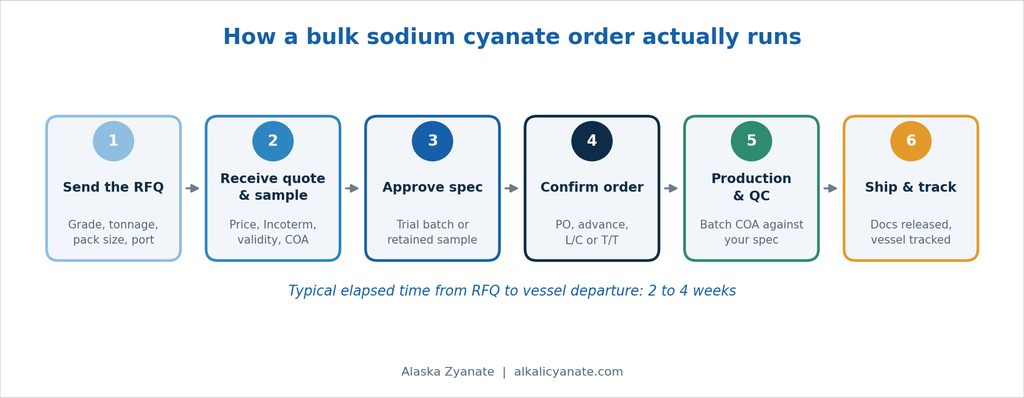
- Grade and full specification, including assay, soda ash and loss on drying limits.
- Quantity for this order, and your expected annual volume if there is one.
- Preferred packaging: 25 kg bag, 50 kg bag, or 500 kg and 1,000 kg FIBC.
- Destination port or delivery address, and the Incoterm you want quoted.
- Required delivery window, stated as a date rather than as soon as possible.
- End application, which lets the supplier flag a better-suited grade before you commit.
- Any regulatory or documentation requirements at your end, such as REACH, import licensing or specific labelling.
You can send all of it through the Alaska Zyanate enquiry form or attach your own specification sheet. Either works, and a specification sheet is faster.
Why buyers choose Alaska Zyanate as a bulk sodium cyanate supplier
Alaska Zyanate has been making alkali cyanates in Ahmedabad since 1997, originally as Erric Industries, and supplies buyers across Europe, North America, the Middle East and Asia from sales offices in Germany and North America. Cyanates are what we make, not a line item in a broad chemical catalogue.
- Manufacturing control, so specification changes are a production decision rather than a negotiation with a third party.
- Batch-specific COA on every consignment, tested against your agreed specification.
- Packaging from 25 kg bags to 1,000 kg FIBC, with liners and marking to your requirement.
- Export documentation handled in house, including EXW, FOB and CIF terms to most destinations.
You can review the full sodium cyanate product specification, browse our alkali cyanate range, or read more about the company.
Frequently asked questions
What is the minimum order quantity for sodium cyanate?
Most suppliers accept bulk orders from 500 kg, with per-tonne commercial pricing usually starting at 5 tonnes. Samples of 25 kg to 100 kg are available for laboratory qualification, but they are priced as samples rather than as bulk material.
How is bulk sodium cyanate packaged for export?
Standard export packaging is 25 kg or 50 kg multi-wall HDPE or paper bags with an inner LDPE liner, palletised and shrink-wrapped. For larger volumes it is supplied in 500 kg or 1,000 kg FIBC jumbo bags with an inner liner and a discharge spout.
How long does a bulk sodium cyanate order take to arrive?
Ex-works lead time from an Indian plant is normally 10 to 15 days. Adding ocean transit and customs, expect roughly six to seven weeks door to door for northern Europe, six to eight weeks for the UK, and eight to ten weeks for the US East Coast.
How much sodium cyanate fits in a shipping container?
A 20 ft container typically carries about 18 tonnes in palletised 25 kg bags or around 20 tonnes in 1,000 kg FIBC. A 40 ft container carries roughly 24 to 26 tonnes, because you reach the payload weight limit before you run out of floor space.
Is sodium cyanate classified as a dangerous good for shipping?
Sodium cyanate carries a harmonised EU classification of harmful if swallowed and harmful to aquatic life with long lasting effects. Transport classification depends on the supplier’s safety data sheet and the mode of transport, so confirm section 14 of the current SDS before booking freight.
Is sodium cyanate the same as sodium cyanide?
No. Sodium cyanate is NaOCN and sodium cyanide is NaCN. They differ in chemistry, hazard profile and regulatory treatment, and sodium cyanide is subject to licensing controls that do not apply to sodium cyanate.
What grades of sodium cyanate are available in bulk?
The two commercial industrial grades are 90% minimum assay with up to 10% sodium carbonate, and 96% minimum assay with up to 4% sodium carbonate. Both carry a maximum loss on drying of 0.50% at 110 degrees C.
What documents come with a bulk sodium cyanate shipment?
A batch-specific certificate of analysis, the current safety data sheet, commercial invoice, packing list, bill of lading, and a certificate of origin where required. Insurance certificates are included on CIF terms.
Can I order a trial quantity before committing to a container?
Yes. A 500 kg to 2 tonne pilot batch in the same packaging as the eventual bulk order is the usual route, and it lets you validate the material on your own line before a full container commitment.