

Yes, you can order potassium cyanate (KOCN, CAS 590-28-3) in bulk, and the process is straightforward once you know what to specify. Decide on your grade (85% technical or 95% pharma), your quantity, and your packaging (25 kg bags, drums or 500-1000 kg jumbo bags), then request a quote. A direct manufacturer will confirm purity with a batch Certificate of Analysis, quote on an Incoterms basis, and arrange export paperwork. Typical lead times run from one to three weeks for domestic orders and three to six weeks for sea export.
Potassium cyanate at a glance
Potassium cyanate is the potassium salt of cyanic acid, an odourless white powder used as a reactive intermediate. It reacts readily with amines to form ureas, semicarbazides and carbamates, which is why pharmaceutical and agrochemical makers keep it on their bill of materials. It is also used in the heat treatment of metals. If you are new to the compound, our primer on what potassium cyanate is covers the chemistry in plain terms.
| Property | Potassium cyanate (KOCN) |
| Chemical formula | KOCN |
| CAS number | 590-28-3 |
| EC number | 209-676-3 |
| Molecular weight | 81.12 g/mol |
| Appearance | White, free-flowing crystalline powder |
| Odour | Odourless |
| Melting point | 315 C |
| Solubility | Readily soluble in water (colourless solution) |
| pH (5% solution) | 10.0 – 11.0 |
Cyanate is not cyanide: confirm this before you buy
This is the single most important check for a new buyer. Potassium cyanate (KOCN) and potassium cyanide (KCN) are different chemicals with different hazards. Cyanate carries the OCN group; cyanide carries the CN group. Under standard GHS classification, potassium cyanate is labelled Warning (harmful if swallowed, eye irritant), not the fatal-poison profile of cyanide salts.
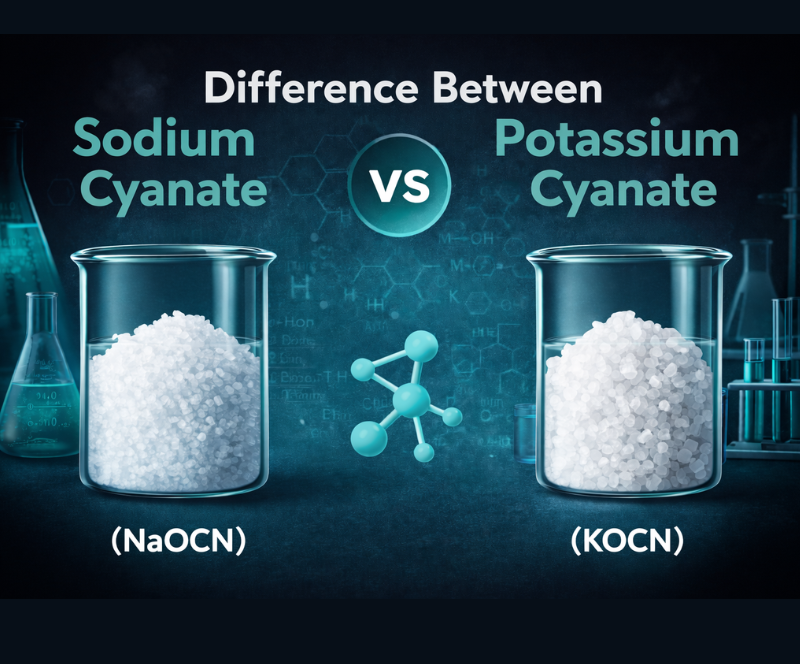
The gap matters for purchasing, transport and compliance. Ordering, documenting or storing the wrong salt causes customs delays at best and serious safety problems at worst. Our explainer on sodium cyanate versus potassium cyanate sets out the related distinctions across the cyanate family.
Choosing your grade: 85% vs 95% KOCN
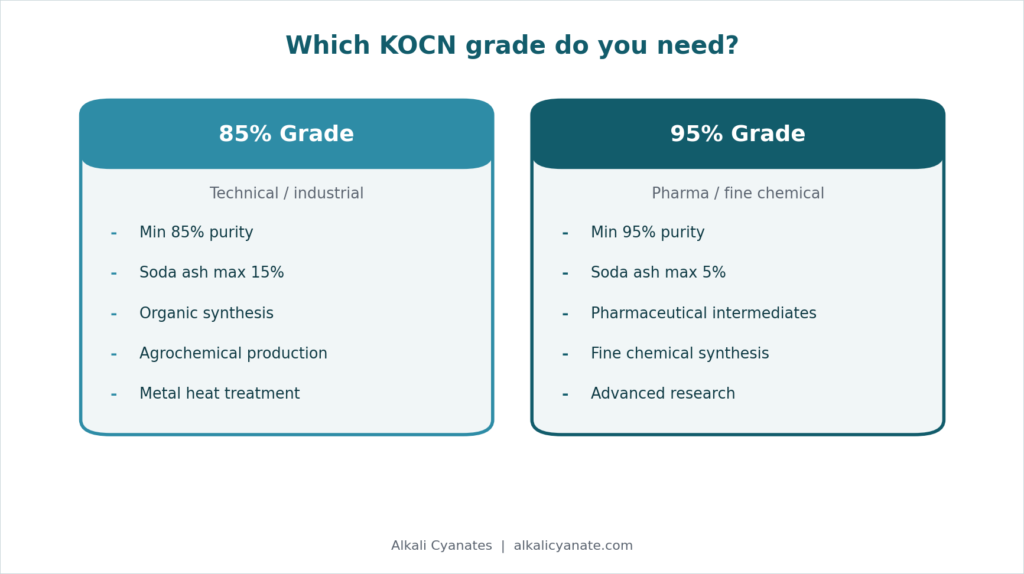
Grade is a purity and cost decision. The 85% technical grade suits high-volume industrial reactions where a little soda ash carry-over is tolerable. The 95% grade, with lower soda ash, suits pharmaceutical intermediates and fine-chemical synthesis where purity drives yield and downstream cleanliness. Review both on our potassium cyanate product page before you decide.
| Specification | 85% grade (technical) | 95% grade (pharma/fine) |
| KOCN purity | Min 85% | Min 95% |
| Soda ash | Max 15% | Max 5% |
| Loss on drying (110 C) | Max 0.50% | Max 0.50% |
| Typical uses | Organic synthesis, agrochemicals, metal treatment | Pharma intermediates, fine chemicals, research |
Minimum order quantity and how bulk pricing works
There is no universal MOQ for potassium cyanate; it depends on the supplier and your grade. Manufacturers usually accept small trial quantities from around 25 kg, then scale to full-container loads for regular buyers. Because purity, packaging and freight all move the number, bulk potassium cyanate is quoted per enquiry rather than sold at a fixed shelf price.
Retail laboratory packs illustrate the point: small lab bottles can work out to tens of dollars per 500 g, while bulk 25 kg and drum quantities are priced on request. The larger and more standardised your order, the lower your unit cost, so it pays to consolidate requirements into fewer, larger shipments.
| Buyer profile | Typical order size | Common packaging |
| First trial / R&D | 25 – 100 kg | 25 kg bags |
| Regular processor | 500 kg – 2 MT | 50 kg bags or drums |
| Distributor / large user | 5 – 20 MT (FCL) | 500-1000 kg FIBC jumbo bags |
What drives the price of a bulk potassium cyanate order
The number on your quote is more than the product. Global demand for KOCN is steady, supported by pharmaceutical, agrochemical and metal-treatment use; one industry estimate put the market at roughly US$150 million in 2024, growing at mid-single digits. Against that backdrop, your delivered cost is shaped by the factors below.
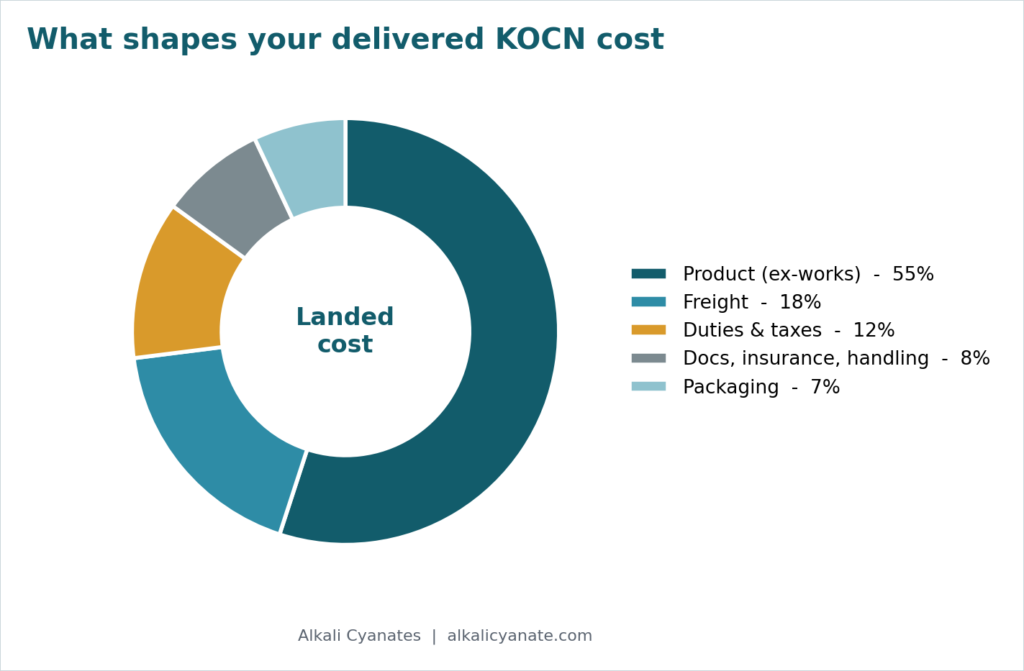
- Grade and purity: 95% costs more per kilo than 85% due to tighter processing.
- Order volume: larger, palletised lots lower the unit price and freight per kilo.
- Packaging: FIBCs are cheaper per kilo than 25 kg bags; lined drums cost more but protect moisture-sensitive lots.
- Freight and Incoterms: sea versus air, and EXW versus CIF, shift who pays for what.
- Duties and documentation: destination tariffs, certificates and insurance add to the landed figure.
Packaging options for bulk supply
Packaging affects handling, shelf life and price, so specify it early. Potassium cyanate is mildly hygroscopic, so bags carry an inner polyethylene liner and drums are lined to keep moisture out. Bulk export material is typically shipped in fibre or steel drums and one-tonne super sacks for full-container or truckload quantities.
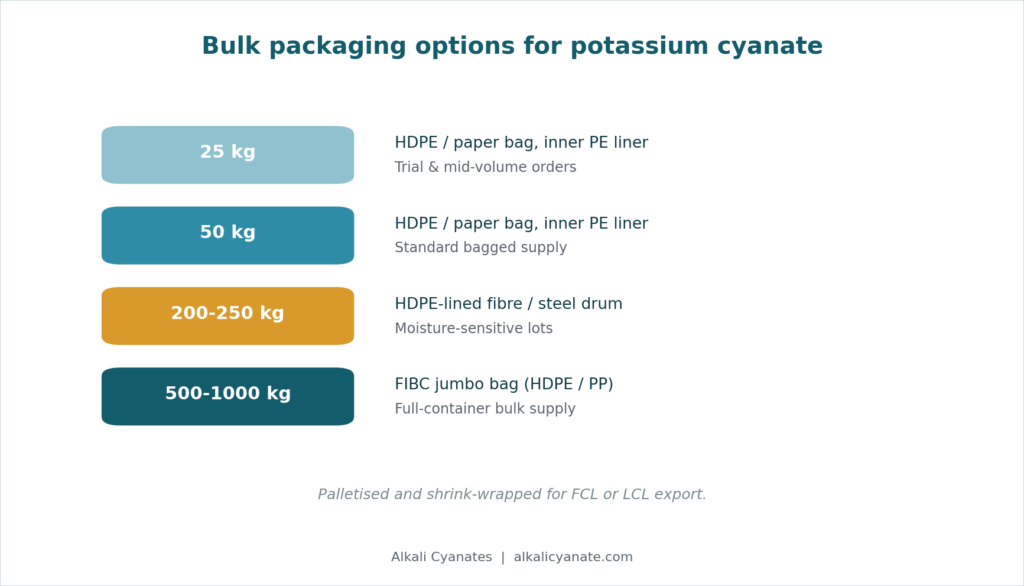
- 25 kg and 50 kg bags: HDPE or paper with an inner liner, ideal for trials and mid-volume use.
- 200-250 kg drums: HDPE-lined fibre or steel drums for moisture-sensitive or long-transit lots.
- 500-1000 kg FIBC jumbo bags: the most economical format for full-container bulk supply.
Lead times: from enquiry to delivery
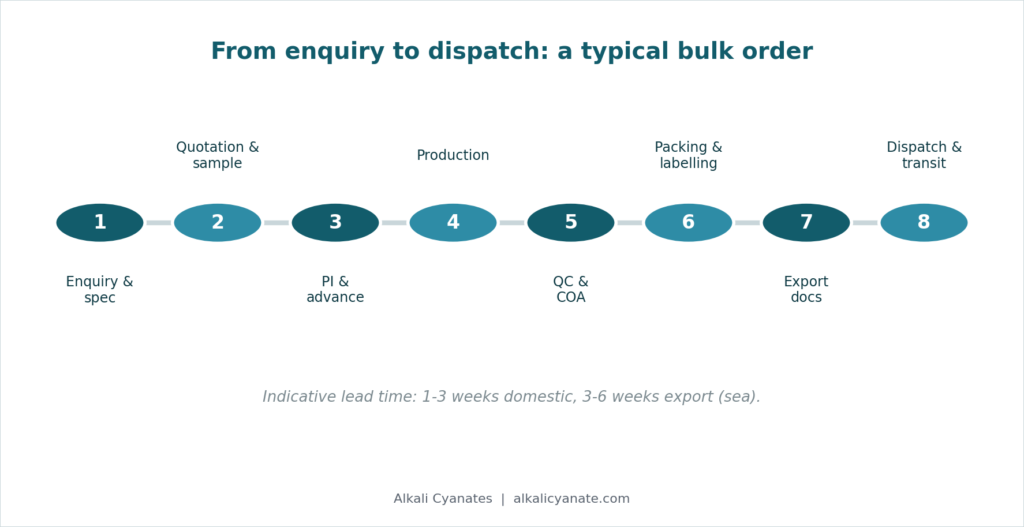
Lead time is production plus logistics. Domestic orders in India typically ship within one to three weeks; export orders by sea usually land in three to six weeks, depending on destination port and documentation. Confirming your grade, packaging and quantity up front removes the most common cause of delay: back-and-forth after the enquiry.
Quality certifications and documents to request
A credible supplier proves quality on paper. Ask for these with your quote, not after you have paid, so you can verify the batch before it ships.
- Certificate of Analysis (COA): batch-level purity, soda ash, loss on drying and pH against spec.
- Safety Data Sheet (SDS/MSDS): handling, storage, PPE and emergency guidance for your EHS team.
- Technical Data Sheet: physical and chemical specification of the grade you are buying.
- ISO certification: evidence of a managed, repeatable quality system.
- Certificate of Origin: required for most cross-border shipments and preferential tariffs.
Shipping and export documentation from India
Buying from an Indian manufacturer keeps sourcing costs competitive, and the export mechanics are well established. Potassium cyanate ships under HS/HSN code 28429090, and domestic Indian sales attract 18% GST (export is generally zero-rated). Our overview of sourcing cyanates from India explains the wider supply picture.
For transport, potassium cyanate is generally not classed among the most restricted dangerous goods (its GHS profile is Acute Tox. 4 and Aquatic Chronic 3), but you should always ship per the current SDS and confirm classification with your freight forwarder. Standard export paperwork includes the commercial invoice, packing list, certificate of origin, COA, SDS and the bill of lading or air waybill.
We regularly supply buyers overseas, including as a potassium cyanate supplier in the USA and for supply into Canada. Check that your quote states Incoterms (EXW, FOB or CIF) so responsibilities are unambiguous.
How to choose a potassium cyanate supplier
Price matters, but reliability protects your production line. Score prospective suppliers against the criteria below and weight them for your situation; a pharma buyer weights purity and documentation, while a high-volume industrial buyer weights capacity and freight.
| What to check | Why it matters |
| Manufacturer vs trader | Direct makers control quality and price; traders add margin and lead time |
| ISO certification & COA | Batch-level proof of purity and consistency |
| Grade range (85% and 95%) | Right purity for your process without overpaying |
| Export experience | Correct HS coding, documents and Incoterms for smooth customs |
| Packaging flexibility | Bags, drums or FIBCs matched to your handling |
| Technical support | SDS guidance plus storage and handling advice when you need it |
It also helps to buy from a supplier with a broad cyanate product range, including sodium cyanate, so you can consolidate related purchases and freight under one relationship.
Placing your bulk order: a simple step-by-step
- Define your spec: grade (85% or 95%), quantity, packaging and destination.
- Request a quote: send the spec and ask for price breaks at several quantity tiers.
- Review documents: check the COA and SDS, and order a sample if the grade is new to you.
- Confirm the proforma invoice: agree Incoterms, lead time and payment terms, then pay the advance.
- Production and QC: the batch is made, tested and released with its Certificate of Analysis.
- Packing and dispatch: goods are labelled, export documents are prepared and the shipment leaves.
Why buy potassium cyanate from Alkali Cyanates
Alkali Cyanates is an ISO-certified manufacturer of potassium and sodium cyanate based in Ahmedabad, India, supplying industrial, agrochemical and pharmaceutical buyers worldwide. We produce both 85% and 95% KOCN grades, ship in your choice of bags, drums or FIBCs, and provide a batch COA and SDS with every consignment.
With sales offices in Germany and North America alongside our Indian plant, we handle export documentation and Incoterms as routine. To discuss quantities and pricing, visit our about page or request a quote from our team.
Frequently asked questions
Can I buy potassium cyanate in bulk?
Yes. Potassium cyanate (KOCN, CAS 590-28-3) is sold in bulk to industrial, agrochemical and pharmaceutical buyers. Manufacturers accept trial quantities from around 25 kg and scale to full-container loads, quoting price per enquiry based on grade, packaging and freight.
What is the minimum order quantity for potassium cyanate?
There is no fixed industry MOQ; it varies by supplier. Trial orders often start near 25 kg, regular supply runs from 500 kg upward, and distributors buy full-container quantities. Ask each supplier for its MOQ and price breaks by tier.
What is the difference between 85% and 95% potassium cyanate?
Purity and soda ash content. The 85% technical grade (soda ash up to 15%) suits industrial and agrochemical use; the 95% grade (soda ash up to 5%) suits pharmaceutical intermediates and fine-chemical synthesis where purity drives yield.
How is potassium cyanate packaged for bulk orders?
In 25 kg and 50 kg lined bags, 200-250 kg lined fibre or steel drums, and 500-1000 kg FIBC jumbo bags. Bags and drums carry inner liners because the material is mildly hygroscopic. Packaging is palletised for FCL or LCL export.
How long does a bulk potassium cyanate order take?
Typically one to three weeks for domestic orders and three to six weeks for sea export, covering production, QC and logistics. Confirming grade, quantity and packaging up front is the fastest way to avoid delays.
Is potassium cyanate the same as potassium cyanide?
No. They are different chemicals. Potassium cyanate (KOCN) carries the cyanate (OCN) group and is classified only as harmful; potassium cyanide (KCN) is a highly toxic cyanide salt. Always match the CAS number 590-28-3 to your order.
Do you export potassium cyanate from India?
Yes. We export potassium cyanate under HS code 28429090 with full documentation, including to the USA, Canada and Europe, on agreed Incoterms. Request a quote with your destination and quantity for a delivered price.