

In 1828, Friedrich Wöhler made history when he accidentally synthesised urea from ammonium cyanate, a moment that overturned the idea that organic compounds could only come from living things. Sodium cyanate, a close relative of that same reaction, has since found its place as a quiet but important industrial chemical.
So, what exactly is sodium cyanate? It is a white crystalline solid with the formula NaOCN (CAS 917-61-3), the sodium salt of cyanic acid. Despite sharing the word “cyanate” with the feared sodium cyanide, it is a distinctly different compound with its own set of properties, applications, and risk profile.
This guide covers everything you need to know: its chemical identity, physical properties, how it is made, where it is used industrially, and how to handle it safely.
What is Sodium Cyanate? Chemical Identity & Definition
Sodium cyanate is an inorganic salt composed of a sodium cation (Na⁺) and a cyanate anion (OCN⁻). Its IUPAC name is sodium cyanate, commonly referred to as NaOCN. The molecular weight is 65.01 g/mol, and it carries the CAS registry number 917-61-3.
The cyanate ion has two resonance structures: ⁻O–C≡N and O=C=N⁻. This gives it a linear geometry and makes it an effective nucleophile in organic reactions — a property exploited widely in synthetic chemistry.
Historically, the cyanate group was integral to Wöhler’s 1822 work on inorganic–organic isomerism, with Berzelius coining the term “isomerism” partly to describe the relationship between cyanic acid and fulminic acid.
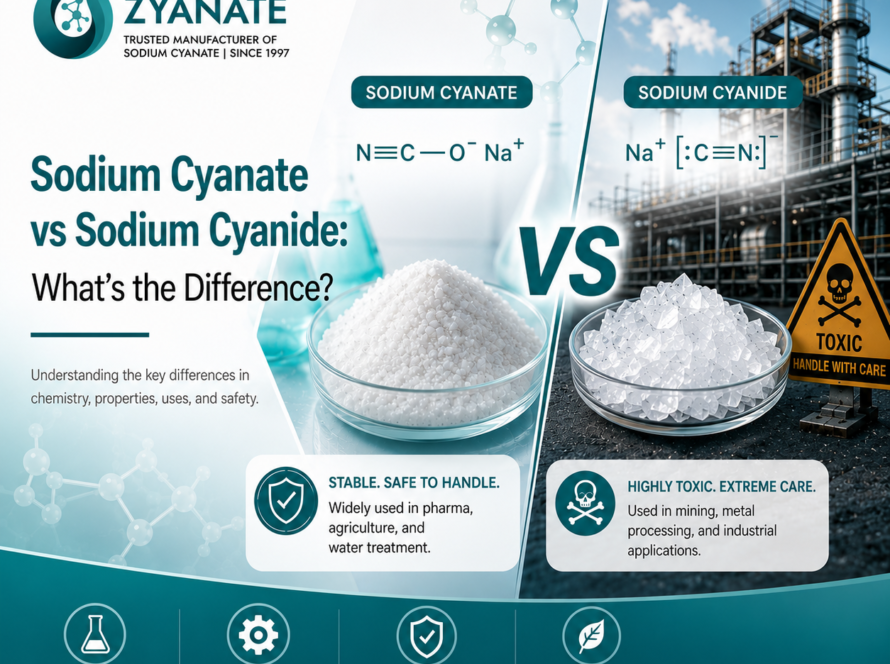
NaOCN vs NaCN — What’s the Difference?
The two compounds are frequently confused. Here is a clear comparison:
| Property | Sodium Cyanate (NaOCN) | Sodium Cyanide (NaCN) |
| Formula | NaOCN | NaCN |
| CAS Number | 917-61-3 | 143-33-9 |
| Molecular Weight | 65.01 g/mol | 49.01 g/mol |
| Anion | Cyanate (OCN⁻) | Cyanide (CN⁻) |
| Acute Toxicity (oral) | Harmful — Cat. 4 | Highly toxic — Cat. 2 |
| Key Uses | Steel hardening, pharma, herbicides | Gold mining, electroplating |
| Smell | Odourless | Faint almond odour |
In short: sodium cyanate is not sodium cyanide. Different formula, different toxicity, different applications. This distinction matters enormously for procurement, safety data sheets, and regulatory compliance.
Physical & Chemical Properties of Sodium Cyanate
Sodium cyanate is a white to light yellow, odorless crystalline powder that is highly soluble in water and thermally stable up to its melting point.
Physical Properties:
- Appearance: White or off-white crystalline solid or powder.
- Molecular Weight: 65.01 g/mol.
- Melting Point: Approximately 550°C.
- Density: 1.937 g/cm³.
- Solubility in Water: Highly soluble, at roughly 110 g/L at 20°C. Solubility increases significantly as temperatures rise.
- Solubility in Ethanol: Sparingly soluble, at roughly 0.22 g/100g at 0°C.
- Crystal Structure: Body-centered rhombohedral (trigonal crystal system).
Chemical Properties:
As an ionic compound, sodium cyanate dissociates readily in aqueous solutions. It acts as an effective nucleophile, which is critical to its role in organic synthesis. It can undergo hydrolysis, occasionally producing ammonia as a byproduct under specific conditions. The compound is incompatible with strong acids and strong oxidizing agents. While stable under normal storage conditions, it is hygroscopic, meaning it will absorb moisture from the surrounding air.
Purity Grades Available
When sourcing this chemical, buyers typically choose between two main grades:
- Technical Grade (88–92%): Primarily used for heavy industrial applications and metallurgical surface treatments.
- High-Purity Grade (98%): Refined for sensitive applications, including pharmaceutical manufacturing and microelectronics.
How is Sodium Cyanate Produced?
The dominant commercial route involves reacting urea with sodium carbonate (soda ash) at temperatures of 550–600 °C. The balanced reaction is:
2 OC(NH₂)₂ + Na₂CO₃ → 2 NaOCN + CO₂ + 2 NH₃ + H₂O
The process produces sodium allophanate as an intermediate, with initial purity typically in the 85–95% range. Subsequent methanol washing and recrystallisation bring this to 98–99% for high-purity applications.
In the laboratory, sodium cyanate can also be prepared by oxidising sodium cyanide with lead(II) oxide, though this route is not commercially viable at scale.
Global Production Landscape
China dominates production; Shanghai Yiji is reported to output approximately 10,000 tonnes per year. European producers including BASF and Evonik manufacture sodium cyanate primarily for high-value pharmaceutical and specialty chemical applications. The finished product is typically packaged in 25 kg PE-lined woven bags or iron drums for safe transport.
What is Sodium Cyanate Used For?
Sodium cyanate’s versatility stems from its nucleophilic cyanate anion, which reacts selectively with a range of electrophilic substrates. Its applications span several major industries.
1. Steel & Metal Hardening (Primary Use)
The largest single application of NaOCN is in carburising and case hardening of steel. In carbonitriding salt baths, sodium cyanate decomposes at elevated temperatures to release both carbon and nitrogen atoms, which diffuse into the steel surface. This creates a hard outer layer (the “case”) while the metal core remains tough. The result is enhanced wear resistance, critical in automotive components, gears, and cutting tools.
2. Organic Synthesis & Pharmaceutical Intermediates
As a nucleophile, NaOCN is used to synthesise ureas, carbamates, and chiral oxazolidones, all important scaffolds in drug molecules. It also plays a role in sickle cell anaemia research, where carbamylation of haemoglobin using cyanate has been explored as a therapeutic approach. The 98% purity grade is standard for pharmaceutical applications.
3. Agriculture: Fast-Acting Herbicide
Sodium cyanate acts as a contact herbicide, disrupting metabolic processes in target plants. It degrades quickly in soil, breaking down to ammonia and carbon dioxide, leaving behind a nitrogenous residue that can act as a mild fertiliser. This makes it a more environmentally transient option compared to persistent synthetic herbicides.
4. Dyes, Textiles & Other Uses
In dye manufacturing, NaOCN serves as a reactive intermediate for producing certain azo and specialty dyestuffs. It has a historical role as a photographic initiator and finds niche uses in electronics manufacturing (98% grade), rubber cross-linking research, and paper and pulp processing.
Industrial Applications: A Closer Look
Water treatment is one such area. Sodium cyanate is a product of the detoxification of sodium cyanide. The oxidation reaction NaCN → NaOCN is a key step in cyanide wastewater treatment, particularly in the mining industry. Further oxidation converts NaOCN to harmless nitrogen and carbon dioxide.
Rubber and polymer manufacturing is another area of research interest. NaOCN has been explored as a cross-linking agent in speciality rubber formulations, though this application remains niche compared to metallurgy and pharma.
NaOCN vs KOCN: Which Should You Use?
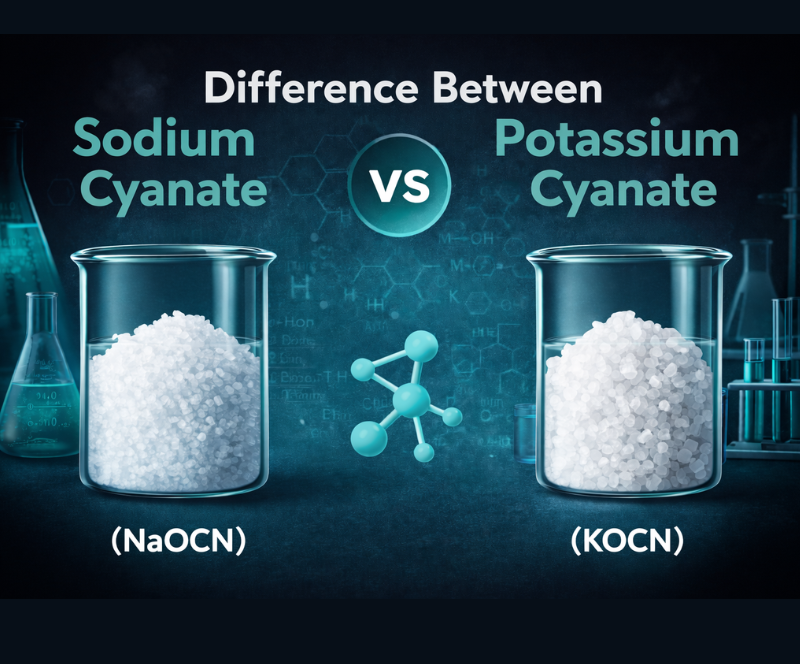
Potassium cyanate (KOCN) is the closest functional alternative to sodium cyanate. Both are used in carbonitriding salt baths, and in many reactions they are interchangeable. KOCN has a slightly higher melting point and different solubility profile, making it preferable in certain high-temperature applications. However, NaOCN is generally more cost-effective and more widely available for bulk industrial purchasing. Your choice should depend on the specific bath chemistry, temperature range, and availability from your supplier.
Safety, Handling & Storage
The LD₅₀ in mice (intraperitoneal) is reported at 260 mg/kg. The primary target organ under repeated exposure is the thyroid gland. Ingestion may cause weight loss and visual changes; inhalation of dust can lead to chest tightness and respiratory irritation.
| Hazard / Requirement | Detail |
| PPE — Eyes | Chemical safety goggles |
| PPE — Skin | Chemical-resistant gloves; lab coat or coverall |
| PPE — Respiratory | Dust respirator (P2 or equivalent) for dusty operations |
| Storage | Cool, dry, well-ventilated; tightly sealed PE or PP containers |
| Incompatibilities | Strong acids, strong oxidising agents |
| Fire | Non-combustible; use water spray, CO₂, or dry chemical |
| Disposal | Licensed hazardous waste disposal facility |
| First Aid — Ingestion | Do not induce vomiting; seek medical attention immediately |
| First Aid — Inhalation | Move to fresh air; seek medical attention if symptoms persist |
Regulatory Status
Sodium cyanate is listed on the major chemical inventories including TSCA (USA), EINECS (EU), IECSC (China), and the Korea ECL. It is not classified as a carcinogen by IARC, and it does not appear on REACH SVHC candidate lists as of 2025. Always consult current SDS documentation from your supplier for the most up-to-date regulatory guidance specific to your region.
Sodium Cyanate vs Related Compounds
Understanding where sodium cyanate sits within the broader family of cyanate and cyanide compounds helps avoid confusion in purchasing, documentation, and safety planning.
| Compound | Formula | Key Use | Toxicity (relative) |
| Sodium Cyanate | NaOCN | Steel hardening, pharma, herbicides | Harmful (Cat. 4) |
| Sodium Cyanide | NaCN | Gold mining, electroplating | Highly Toxic (Cat. 2) |
| Potassium Cyanate | KOCN | Metal treatment, synthesis | Harmful (similar to NaOCN) |
| Ammonium Cyanate | NH₄OCN | Converts to urea (Wöhler) | Low hazard |
| Cyanic Acid | HCNO | Generated in situ from NaOCN | Corrosive |
The key message: cyanate ≠ cyanide. Sodium cyanate lacks the CN⁻ anion responsible for the severe acute toxicity of sodium cyanide. Do not allow these two compounds to be confused in labelling, SDS filing, or customs documentation.
Conclusion
Sodium cyanate (NaOCN) is a versatile industrial chemical with a well-established role in steel hardening, pharmaceutical synthesis, agriculture, and organic chemistry. Its global market is growing steadily, driven by demand from the automotive, aerospace, and specialty chemicals sectors.
The most important safety point to remember: sodium cyanate is not sodium cyanide. Understanding this distinction protects your team and ensures accurate compliance documentation. Always use the correct purity grade for your application: 88–92% for most industrial processes, 98% for pharmaceutical and electronics work.